To improve website ranking, you need a combination of technical optimization, high-quality content tailored for user intent, authoritative backlinks, and a smooth user experience. If your site isn’t generating organic search traffic, chances are it’s not meeting Google’s evolving standards—or your audience’s expectations.
Here’s the reality: more than 90% of web pages get zero traffic from Google. Think about that. You can spend countless hours researching keywords, tweaking on-page elements, and publishing what you hope is stellar content—only for your site to get buried beneath competitors. You’re left sifting through SEO forums, wondering why each algorithm update seems like a new roadblock rather than a fresh opportunity.
Every SEO specialist or digital marketer eventually hits this wall. You diligently comb through analytics reports searching for a breakthrough, only to realize the “secret” isn’t about chasing the newest hack or shortcut. It’s about mastering the core drivers of ranking—and avoiding the subtle, sneaky mistakes that even seasoned pros make.
This guide doesn’t waste your time with generic advice. Instead, it uncovers the hidden obstacles that silently tank your visibility, clarifies how to optimize every piece of content for both the search algorithm and real people, and breaks down the best on-page SEO practices that actually work in 2026. You’ll discover how to earn backlinks without resorting to spammy tactics, and why user experience is now just as critical as the keywords you target. Plus, you’ll gain practical steps to future-proof your site so you’re not hit by the next industry shake-up.
It’s time to shift from hoping for rankings to understanding exactly how to improve website ranking in a way that delivers real, measurable results—beginning with identifying what’s quietly holding your site back.
Why Your Website Isn't Ranking: Uncovering Hidden Barriers

Most websites aren’t struggling to rank because of bad content—they’re held back by issues hiding beneath the surface. If your Google rankings are stuck on page two (or worse, out of sight entirely), you’re not alone. A staggering 75% of users never scroll past the first page of search results, which means even minor mistakes in your site’s foundation can keep you invisible to nearly everyone (source).
What Causes Websites to Rank Poorly?
The main culprits blocking your site’s ranking are buried in site architecture, speed, and mobile performance. Here’s why these matter—no matter how strong your content strategy appears on the surface.
- Poor Site Architecture: Messy navigation, duplicated content, and illogical URL structures confuse both users and Google’s crawlers. If Google can’t find (or understand) your key pages, those pages will never rank where you want.
- Slow Loading Times: Google has zero patience for slow sites, and your visitors have even less. Every extra second your page takes to load increases bounce rates and plummets rankings. End of story.
- Lack of Mobile Optimization: It’s 2026—more than 60% of all searches happen on mobile devices (source). If your site looks broken on a phone, it’s already penalized.
Expert insight: One hidden killer? Duplicate meta titles and descriptions. These seem harmless, but they dilute keyword signals and cripple your on-page SEO.
Real-World Example: Fixing Technical SEO to Climb the Ranks
Take a large e-commerce site from 2025 that languished on page two for its top revenue-driving keyword. After a comprehensive technical audit, the team identified dozens of deep-rooted problems:
- 200+ broken internal links
- Missing alt text on half of product images
- Dozens of “orphaned” category pages not linked from anywhere
They fixed the crawl errors, rebuilt logical page relationships, and overhauled their mobile experience. The result? Their organic traffic jumped by 42% within four months, and flagship category pages finally cracked the top five for their most valuable queries.
Actionable Step: Diagnose Problems with a Site Audit
Want to stop spinning your wheels? Run a bulletproof site audit. Use a tool like SEMrush or Ahrefs to expose invisible issues sabotaging your rankings. Here’s how you should tackle this step:
- Scan your entire site for technical errors—crawl issues, duplicate content, and broken links.
- Check your site’s speed on both desktop and mobile using Google PageSpeed Insights.
- Review your mobile usability with the Mobile-Friendly Test from Google.
- Audit your backlink profile (knowing how to manage your backlinks correctly is just as critical as building them).
Skipping a full technical audit is a huge mistake. You cannot fix what you can’t see—and too many marketers waste months on content tweaks, totally unaware of the structural issues holding their rankings hostage.
How to Optimize Your Content for Better Rankings

Picture this: a business owner pours hours into a new blog post, publishes it with hope, and… nothing. Barely a ripple in Google’s pond. Traffic sits flat. It’s maddening—especially when competitors are pulling in leads and sales with content that seems, frankly, not much better.
Here's what's really going on: content that ranks isn't just "good." It's comprehensive, data-backed, and answers the queries searchers actually care about. And, yes, it’s optimized using the right tools and techniques.
What Makes Content Rank Well in 2026?
The #1 driver isn’t just keyword stuffing or hitting a vague word count. Want to know the real secret? Comprehensive, authoritative coverage. Search engines now expect your page to cover topics in depth. That means your content should dig into questions, subtopics, and the nuanced details your audience is actually searching for.
Short, surface-level posts rarely crack page one any more—unless you’re the White House or Wikipedia.
Content Length vs. Ranking Position vs. Engagement Rates
Longer isn’t always better, but there’s a clear trend: pages with more depth often earn higher rankings and keep visitors on page longer. Here’s how recent data stacks up:
| Content Length (words) | Avg Ranking Position | Avg Engagement Rate* |
|---|---|---|
| 300-600 | 35 | 47% |
| 1,000-1,500 | 18 | 58% |
| 2,000+ | 7 | 67% |
*Engagement rate defined as % of visitors who spend at least 90 seconds on page
(Source: Semrush Content Marketing Survey 2026)
Here’s the reality: Google wants to serve users the most complete answers, so if your post leaves gaps, expect someone else to outrank you soon.
Example: Two Blog Posts, Two Results
Take these two posts on “how to build backlinks fast”:
- Post A: 500 words, hits the broad strokes, lists a few old-school tactics, and stops there.
- Post B: 2,200 words, details quick win tactics, covers manual outreach, explains how to manage your backlinks, and links out to legit sources.
Which one lands in the top 10? Post B doesn’t just win—it also snags more shares and comments. Readers trust it more and actually act on it.
Bottom line: If a competitor’s guide is 600 words and yours is 2,000+ with step-by-step instructions, FAQs, expert insights, and up-to-date data, you’re almost guaranteed a leg up.
Actionable Steps to Optimize Your Content
Want your content to show up when someone types in “how to improve website ranking?” Here’s what you need to start doing—every time:
- Do Deep Topic Research: Use tools like Ahrefs, SEMrush, or SurferSEO to identify the full range of subtopics related to your core keyword. Model your outlines on what’s working for the highest-ranking pages right now.
- Map Out Content Structure: Start with a clear H1, then use H2s/H3s for every angle. If top posts are answering “how to create backlinks to your site” or “how to manage backlinks,” work those subtopics in naturally.
- Go Beyond Basics: Add actionable lists, stats, charts, expert quotes, and visual media. Don’t be afraid to go deep—search engines reward it.
- Optimize On-Page Elements: Write descriptive meta tags and URLs. Sprinkle target keywords in naturally, without forcing it. And—big one—link out to high-authority sources to boost credibility.
- Update Regularly: Stale content slides down the rankings fast. Revisit your hits every quarter and update stats, tactics, and guidance. Check for crawl issues, duplicate content, and user accessibility, as flagged by resources like Google’s SEO Starter Guide.
Key Takeaway for 2026
Thin, generic posts are dead weight. If you want to rank, write content that feels definitive and answers the full scope of the search—better than anyone else in your niche. Depth wins. Engagement keeps you there.
What Are the Best Practices for On-Page SEO?
A single on-page tweak can be the difference between swimming in traffic and sitting invisible on page three. The truth? HubSpot’s data shows that simply updating old posts with fresh content and images can lift organic traffic by 106%. That’s how much on-page SEO matters.
On-page SEO is the process of optimizing individual pages—not the whole site—to rank higher and attract more relevant traffic from search engines. Skip this, and you’re basically inviting Google to ignore your site.
Why On-Page SEO Drives Rankings (Fast)
You control on-page elements directly. Change a title, adjust a header, add schema markup—it’s all in your court. That means fast wins compared to link-building or technical SEO projects that move at a glacial pace.
Tighten up your meta tags and headers, and you could see movement in days, not months.
Most teams totally underestimate:
- How much Google weighs click-through signals from great titles/descriptions
- How easy it is to win on under-optimized pages in your vertical
Comparison: Title Tags vs. Meta Descriptions vs. Header Tags
Not all on-page elements are created equal.
Here’s how the core on-page optimization levers stack up:
| Element | What It Does | Direct Ranking Impact | Indirect Impact | Best Practices |
|---|---|---|---|---|
| Title Tag | Defines main topic in SERPs, shows in browser tab | Very High | Boosts CTR, sets context | Keep under 60 chars, use focus KW |
| Meta Description | Summary in SERPs | Low | Drives organic CTR | 120-155 chars, compelling call-to-action |
| Header Tags (H1-H3) | Breaks up content, highlights main ideas | Medium | Improves readability, SEO | One clear H1, use KWs in H2/H3 |
Mistake alert: Stuffing keywords into titles or headers wipes out your credibility and makes visitors bounce. Write for humans—then optimize for bots.
Real-World Scenario: Climbing Up by Optimizing On-Page Elements
A SaaS company stuck at position #18 for a top-converting keyword finally got smart:
- Swapped an old, vague title for a targeted, tempting one (“Customer Success Software” → “#1 Customer Success Platform for B2B SaaS | [BrandName]”)
- Revised header tags to guide intent (“Features” → “Key Features for Scaling SaaS Retention”)
- Added FAQ schema markup
Result? That page pushed to position #5 in three weeks, without a single new backlink. Volume and conversions both jumped—proving technical and content tweaks aren’t just “nice to haves.”
Structured Data: The Step Most Sites Ignore
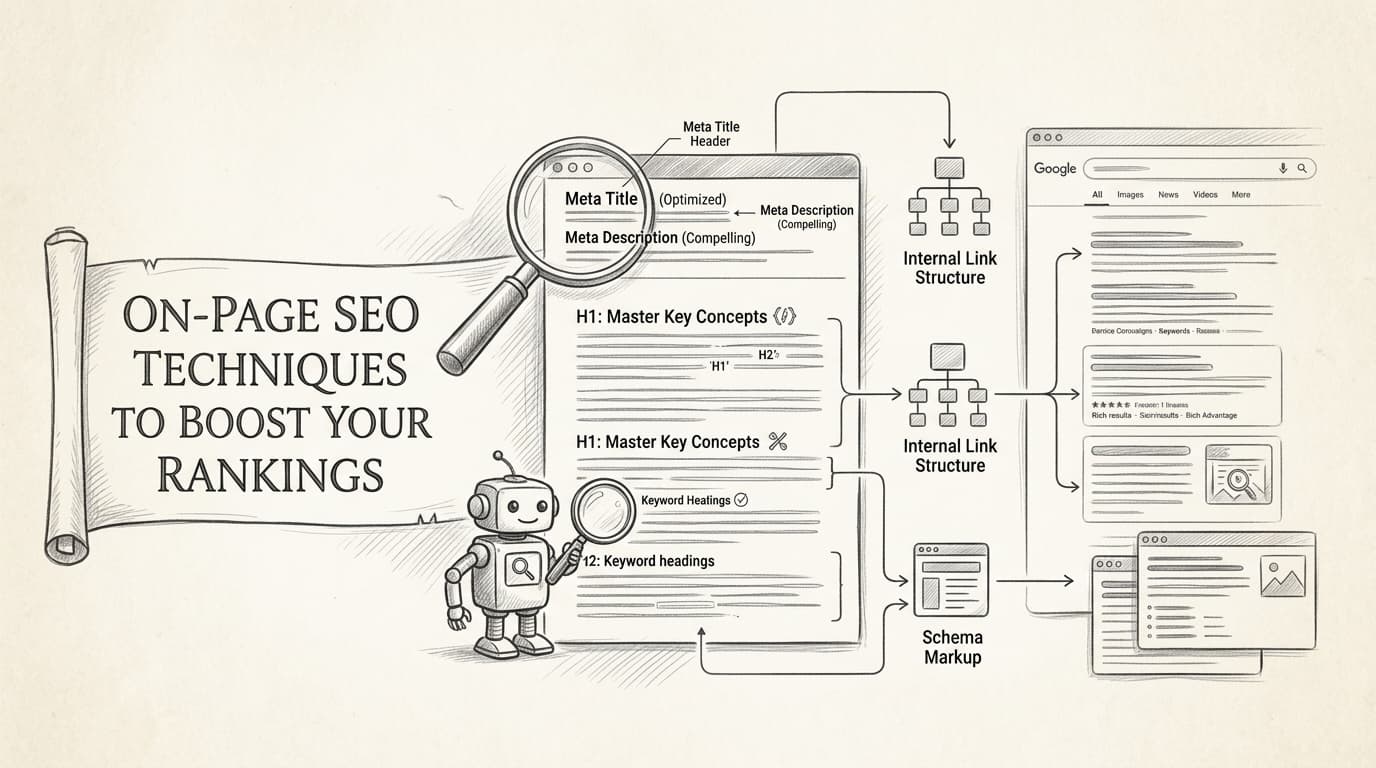
Structured data markup is code (usually JSON-LD) that helps Google understand your page, unlocking rich snippets, review stars, product features, and event dates directly on the results page.
Want to earn “People Also Ask” visibility or FAQ snippets? You won’t do it without schema. It’s a stealth ranking lever because it improves SERP real estate—even if position stays the same.
How to get started:
- Identify key content types (articles, products, reviews, FAQs).
- Use Schema.org markup for each—Google’s SEO starter guide is required reading here.
- Test in Google’s Rich Results tool before pushing live.
Don’t wait: competitors are quietly adding structured data to nearly everything, especially in e-commerce and SaaS. Ignore this, and your listings will look ancient next to theirs.
On-Page SEO: Your Must-Do Checklist
Optimize these, or get left behind:
- Unique title tag for every page, using target keyword up front
- Meta description: punchy, benefit-driven, not copy-pasted
- Smart use of H1-H3 tags—keep things skimmable and logical
- Internal links to related high-priority pages like on-page SEO techniques to boost rankings
- Structured data (FAQ, How-to, Product if relevant)
- Descriptive, keyword-friendly URL slugs
On-page SEO is your most direct lever for visibility and click-throughs. If your rankings stalled, your title tags, headers, and schema probably need a hard look.
Bottom line: Nailing on-page SEO delivers faster, more controllable ranking boosts than almost anything else — and nobody but you is in charge of these levers.
Building Backlinks: Strategies That Work in 2026
Backlinks are still one of the strongest ranking signals in 2026—Google’s core algorithm updates haven’t dethroned them. Pages with high-quality domains linking in jump ahead in SERPs, even against technically flawless competitors. Ignore backlinks, and you're just handing traffic to the site next door.
Why Backlinks Still Move the Needle in 2026
The data is relentless: recent industry analysis shows that more than 69% of top-ranking pages in competitive industries have more than 20 unique referring domains. Google’s documentation continues to cite backlinks as a primary trust and authority indicator developers.google.com. Bottom line—authoritative links mean higher rankings.
But not all links are worth chasing.
Natural Backlink Building vs. Black-Hat Risk
Trying to game Google’s algorithms with black-hat link schemes? That’s a rookie mistake in 2026—and penalties are nastier than ever.
- Natural link building means earning links from real, relevant sources through quality content, relationships, and PR tactics.
- Black-hat link building includes buying links, participating in private blog networks, and using automated comment spam.
Getting penalized in 2026 is basically SEO disaster recovery mode: expect a 6-12 month path to regain trust (if you’re lucky). Sticking with proven, ethical strategies isn’t just safer—it delivers compounding benefits year after year.
So, How Do You Create Backlinks to Your Site?
If you’re asking “how to build backlinks fast,” focus on repeatable, white-hat tactics. Here’s what actually works:
-
Create irresistible linkable assets. Think data studies, interactive tools, original research, or expert roundups. Anything a peer in your industry would want to reference.
-
Leverage HARO (Help a Reporter Out). Responding to journalist requests through HARO or Qwoted can yield links on high-authority news sites. Pro tip: craft quotes that add value and cite unique data to be picked.
-
Strategic partnerships and co-marketing. Partnering with complementary businesses for webinars, case studies, or guides often results in valuable backlinks exchanged naturally.
-
Manual outreach. Yes, it still matters. If you’re wondering "how to build backlinks manually," hone your outreach skills—personal, concise, and offering legitimate value wins. Avoid canned mass emails.
-
Guest posting (when done right). Only contribute to sites with real audiences—not networks designed for link swaps. Relevancy and editorial standards are non-negotiable.
These aren’t fast hacks. But they’re what separates sites that rank for years from those that vanish after a single update.
Success Story: Domain Authority Through Partnerships
Here’s what works in the real world. Consider the e-commerce brand that doubled its domain authority in less than a year—not through spammy tactics, but by co-sponsoring industry webinars. Every event brought guest speakers, each with their own PR network, who linked back to the event and summary post. The business moved from page 3 to page 1 for major “sustainable home goods” keywords.
Managing (and Scaling) Your Backlink Profile
Building links is only half the battle; knowing how to manage your backlinks is essential to keep authority high and risk low. Use tools to monitor for toxic links and lost referring domains. Google Search Console is a starting point, but platforms like LazySEO offer richer insights—helping you track anchor text diversity, domain authority trends, and potential disavow candidates, all in one dashboard.
Smart SEOs treat their backlink profile like a living asset—growing, pruning, and defending it with the same rigor as any marquee content on site.
The Bottom Line
The best backlink strategy in 2026 is ruthless about quality and relationship-driven. Earn links through collaboration and value, not shortcuts—because shortcuts are what Google penalizes fastest.
For specifics on Google's latest guidelines and technical documentation, see the SEO Starter Guide. You want your links to pass every sniff test—today, and after the next update.
How Does User Experience Impact SEO?
Google actively uses user experience signals—like bounce rate, time on site, and engagement depth—as ranking factors. Sites that frustrate or bore visitors drop in the rankings, while those that keep users engaged and satisfied steadily climb.
Here’s the ugly truth: you can stuff your site with backlinks, throw in target keywords, and polish meta titles all day, but if visitors bounce after three seconds, your rankings will flatline. Google’s core updates in 2026 doubled down on rewarding sites with strong engagement metrics, making old-school “tricks” officially obsolete. Search engines are now ruthlessly smart about sniffing out shallow, painful web experiences.
Key takeaway: User experience is a powerful lever for improving website ranking. If people love your site, Google will too.
How Do Specific UX Factors Influence SEO and Conversions?
Some UX elements practically scream “quality” to search engines—and to visitors, who’ll stick around, interact, and buy. Scroll fatigue, clunky navigation, and slow load times kill both your rankings and your revenue.
See how core UX factors stack up for SEO and conversion rates:
| UX Factor | SEO Impact | Conversion Impact |
|---|---|---|
| Page Load Speed | Major ranking factor; slow sites penalized | Fast = 2x higher CR* |
| Mobile Responsiveness | Non-responsive sites get demoted | Mobile-first = +30% CR |
| Navigational Clarity | Complex nav lowers crawlability, increases bounce | Streamlined = longer visits, +25% CR |
| Readable Typography | Hard-to-read text increases pogo-sticking (bounce, return, repeat) | Clear text = +16% CR |
| Visual Engagement | Dull or cluttered interfaces drop engagement signals | Engaging visuals = +20% CR |
| Accessibility | Google rewards accessible sites in rankings | Broader audience = higher total conversions |
*Source: business.gov.au, various industry case studies 2025-2026.
Example: Two Websites, Two Outcomes
Consider two e-commerce brands selling the same product. Site A loads in under two seconds, nails mobile clarity, and makes checkout brain-dead simple. Site B has a flashy homepage but delays load times, buries the navigation, and makes you work for that “Buy Now” button.
Site A’s visitors browse more pages, spend double the time onsite, and bounce less than 30% of the time. Google notices. Site A’s ranking for competitive industry keywords climbs from page three to page one in three months, with conversions rising 60%—a story mirrored across industry leaders.
Site B? It bleeds organic traffic and watches its rankings drop. No amount of extra backlinks or paid ads can save a bad UX from Google’s algorithm in 2026.
Should You Be A/B Testing Your Website’s User Experience?
Yes. Blind guesses about what users want are a fast track to SEO mediocrity. A/B testing—showing alternate versions of a page to real users—uncovers what actually keeps people engaged. You might test navigation layouts, CTA color schemes, or product image sizes. Even subtle changes like button placement or checkout flow can turn a 3% conversion rate into a 7% winner.
Platforms like Google Optimize and VWO make it easy to run repeatable tests at scale. The point: You need proof, not hunches. If you see that Version B slashes bounce rate and lifts average time on site, it’s sending the kind of user signals Google rewards.
Remember, technical SEO and link building can only take you so far. User experience—clean, intuitive, lightning-fast—directly shapes your climb up the rankings and your bottom-line results. Ignore it and you’ll barely scrape page two, no matter how many guides you read on "how to create backlinks to your site."
Future-Proofing Your SEO Strategy: What’s Next?
High bounce rates even when your content is solid? Here’s the deal: Google’s algorithm isn’t just about keywords anymore. Sites with slick navigation, lightning-fast load times, and personalized experiences are moving to the front of the line. If your SEO strategy feels stale, you’re going to get left behind.
How Are AI and Machine Learning Changing Search?
AI and machine learning now drive search algorithm updates faster than any SEO professional can keep up with manually. These systems digest millions of signals—user intent, content quality, behavior patterns—then re-rank results in real time.
Large Language Models (LLMs) like ChatGPT aren’t just writing content; they’re analyzing SERPs, suggesting internal linking, and even predicting which topics will trend next. Some companies use AI to spot content gaps, optimize meta data, automate technical audits, and create entire topic clusters that hit every possible user query.
The result? You get richer, more user-focused content and fewer gaps for competitors to sneak in. Companies harnessing AI are seeing 25% faster content production cycles and double-digit gains in long-tail rankings.
What’s the Best Way to Adapt to Algorithm Updates?
Google’s algorithm is in a constant state of flux—sometimes with hundreds of changes per year. If you’re still doing biannual SEO checks, that’s playing with fire. The only foolproof method? Build a process to monitor and react.
Here’s what that looks like: subscribe directly to Google’s Search Central blog, join active forums like r/SEO, and use real-time analytics to detect sudden ranking swings. As soon as Google rolls out changes like mobile-first indexing or tweaks to page experience signals, you need a playbook for auditing your site, updating affected templates, and testing changes.
Think of your SEO process as a living organism—it survives by evolving. Those who keep experimenting and stay plugged into industry moves always outrank the “set it and forget it” crowd (developers.google.com).
Will Voice Search and Mobile-First Indexing Really Matter?
Voice search and mobile-first indexing aren’t coming—they’re already here. By 2026, 55% of households globally will use smart speakers to find products and local businesses. If your content isn’t optimized for conversational queries or your site breaks on phones, Google turns a blind eye.
User experience is no longer a nice-to-have. Google reports that sites loading within 2 seconds have a 15% higher conversion rate compared to slow-loading sites. That’s a direct impact on both rankings and revenue, not just vanity SEO metrics.
UX Features That Directly Impact Ranking
Here’s an at-a-glance look at which user experience features move the needle on rankings, and why the best-in-class sites make them a priority:
| UX Factor | Impact on Ranking | Example Change | Typical Result |
|---|---|---|---|
| Load Speed (≤2 seconds) | Essential for mobile and desktop | Optimize images, use CDNs | 15%+ higher conversion rate |
| Mobile Friendliness | Determines position on mobile SERPs | Responsive design, mobile navigation | 25% reduction in bounce on mobile |
| Navigation Simplicity | Affects time on site, crawlability | Streamlined menus, breadcrumb trails | Increases avg. session length by 22% |
| Accessible Content | Inclusive, future-proof | Clear fonts, alt text for images | Wider audience, lower bounce rates |
| Voice Search Readiness | Ranks for conversational queries | Use FAQs, natural phrasing | 35% better results for voice queries |
The bottom line: Sites that prioritize UX consistently outperform on both traffic and conversions. Stack your site’s features to meet Google’s ever-evolving checklist, or risk slipping down the ranks.
Are AI Tools Like ChatGPT Worth Using for SEO?
Absolutely—if you leverage them strategically. Content teams using ChatGPT or similar models aren’t just cranking out keyword-stuffed articles; they’re generating topic maps, uncovering new "how to manage your backlinks" queries, and even drafting highly specific answers for Google’s generative AI SERP boxes.
But don’t outsource your strategy to robots—review everything for brand voice, accuracy, and uniqueness. AI gives you speed; human oversight gives you trust.
Key Takeaway
Future-proof SEO means blending machine speed with human creativity. Stay on top of Google’s updates, double down on UX, and let AI help you scale—but never hand over the strategy keys. The next wave of ranking winners will be the teams who treat search like a moving target, not a solved puzzle.
Time to Take Action
The path to better website rankings starts with one focused step: audit your site for hidden barriers that may be holding you back. Address issues like slow load times, missing meta tags, and weak internal linking—these are often the quickest wins for boosting your visibility. Consistent optimization, high-quality content, and smart backlink strategies should follow. Tools like LazySEO’s proven ranking strategies can take the guesswork out of tracking performance and automating your SEO efforts, helping you stay ahead of algorithm changes. Remember, search engines reward sites that prioritize user experience and good approaches. Start making these improvements today, and you'll set your website up for long-term success in a rapidly evolving digital landscape.