How to Automate SEO Content Creation in 2026
SEO in 2026 is all about speed and scale. Publishing 20+ high-quality articles per month has become the norm, and AI-driven tools like LazySEO make it possible. With automation, you can handle keyword research, content creation, internal linking, and even publishing - all while cutting manual workload by up to 80%.
Here’s the process in a nutshell:
- Start with LazySEO's $1 trial to test its AI-powered features.
- Automate keyword research to find gaps and opportunities faster.
- Generate and optimize content that ranks well for both Google and AI search engines.
- Schedule and auto-publish articles directly to your CMS.
- Track performance and refine your strategy based on analytics.
LazySEO’s tools help you stay competitive by producing 30+ articles monthly with minimal effort. If you're not automating your SEO by now, you’re falling behind.
::: @figure 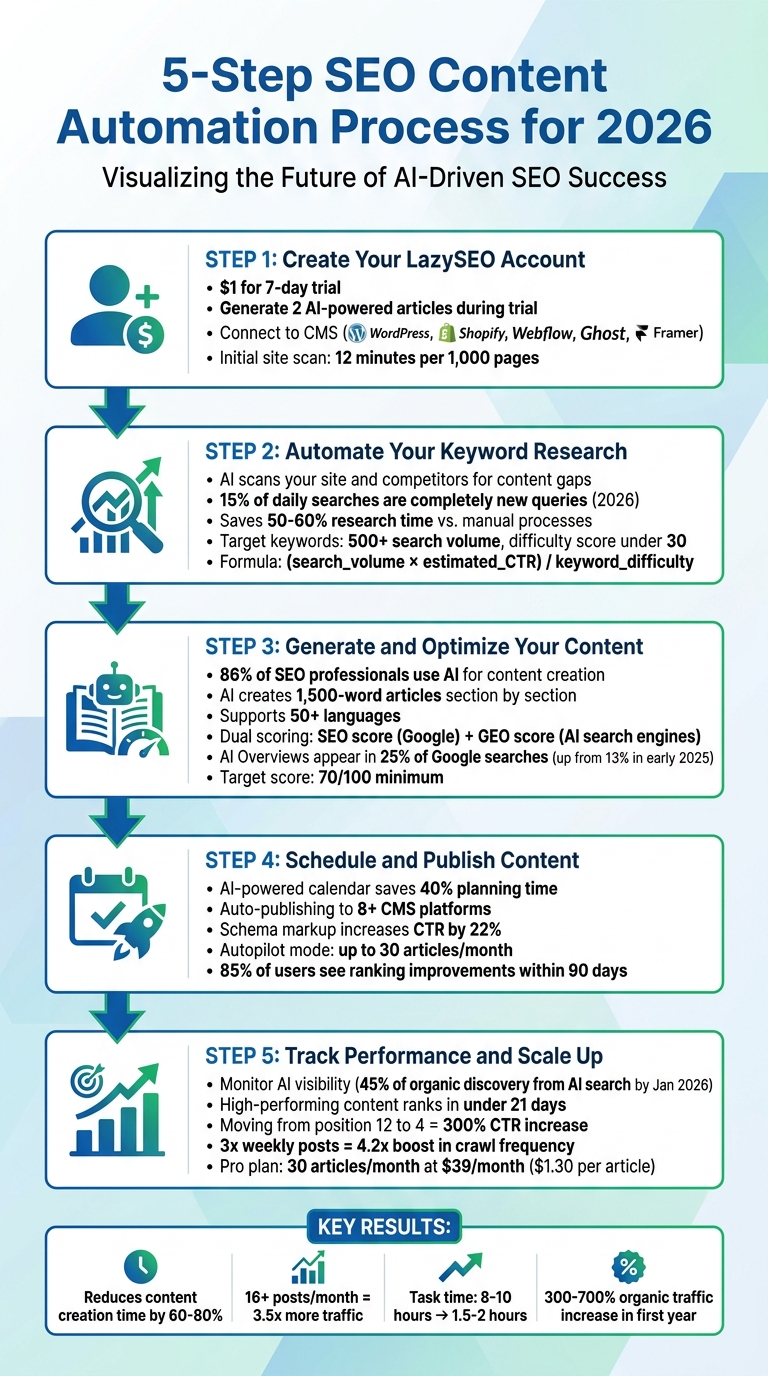 {5-Step SEO Content Automation Process for 2026}
:::
{5-Step SEO Content Automation Process for 2026}
:::
Step 1: Create Your LazySEO Account
Register for the $1 Trial
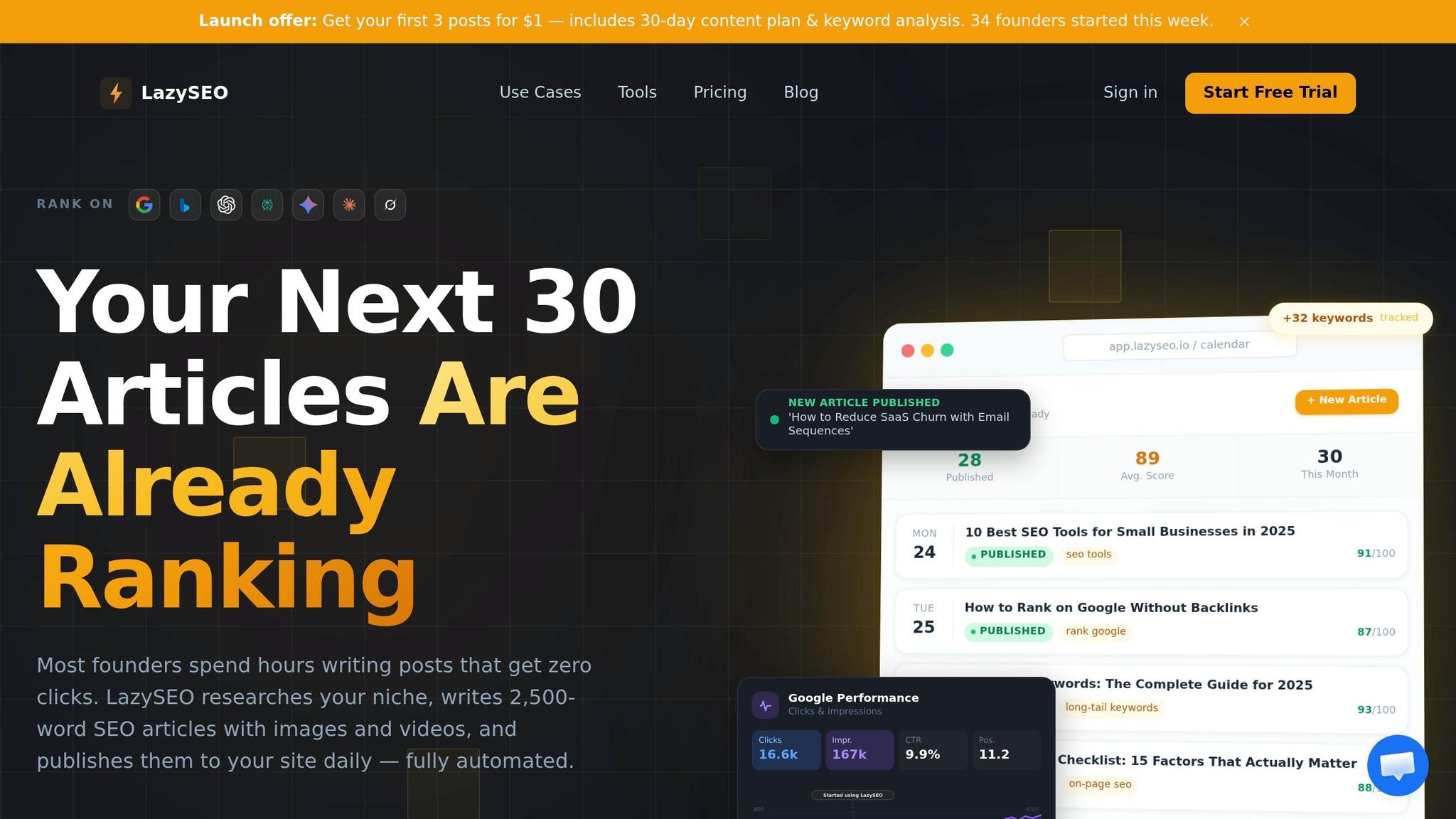
Visit LazySEO's website to sign up for their 7-day trial, priced at just $1. This trial provides full access to the platform's features, including the ability to generate two AI-powered articles during the trial period. You'll need a valid email address and payment method to register, but there's no obligation - cancel anytime before the trial ends if you decide it's not a fit for your workflow.
This trial period allows you to explore the entire automation process, from keyword research to auto-publishing, without committing to the $39/month Pro plan. Many users find that creating their first two articles is enough to determine if the platform's AI tools and SEO functionality match their brand's needs.
Explore the Dashboard
After logging in, you'll arrive at the main dashboard, which serves as the command center for all SEO automation tasks. The interface is designed to be intuitive: keyword research tools are on the left, content generation options are in the center, and your content calendar for scheduling is on the right.
Take a moment to familiarize yourself with the sections. You'll find tools like the SEO quality scoring system, which evaluates content before publishing, a SERP analysis feature to check rankings for your targeted keywords, and an internal linking module that connects related articles automatically. The dashboard also tracks your monthly article quota - 30 SEO-optimized pieces on the Pro plan - so you always know how many articles you can still generate.
Connect Your CMS
LazySEO integrates seamlessly with platforms like WordPress, Shopify, Webflow, Ghost, and Framer through dedicated plugins or API connections. For WordPress, simply install the official LazySEO plugin from your dashboard and authenticate using OAuth or an App Password. Shopify users will need to generate an Admin API Token in their Shopify settings and paste it into LazySEO's integration panel.
During setup, you'll map key fields - Title, Slug, Meta Description, and Body - to ensure articles are placed correctly in your CMS. To start, set the publishing mode to "Draft" so you can review content formatting and attribution before it goes live. The initial site scan takes approximately 12 minutes for every 1,000 pages [7]. This scan identifies issues like broken links, missing alt text, and thin content that could hurt your site's visibility in search engines and AI-driven summaries.
"Automation should serve your editors, not sidestep them." – SEOPro AI [4]
Once the scan is complete, LazySEO establishes a baseline for keyword tracking and highlights topical clusters that can help boost your site's authority. From here, you can dive into automated keyword research to optimize your workflow even further.
sbb-itb-851db2b
Step 2: Automate Your Keyword Research
Find Keywords Automatically
LazySEO's AI engine simplifies keyword research by scanning your website and competitor pages to identify the language they rank for and pinpoint content gaps - those valuable keywords your competitors are targeting that you may have missed [9]. Starting with a few seed terms, the platform leverages large language models to uncover niche keywords, alternatives, and long-tail queries that traditional methods often overlook. It also integrates with search APIs to fetch live metrics like search volume, competition levels, and cost-per-click (CPC). This approach uncovers search terms you might not have considered.
Here's an interesting stat: In 2026, around 15% of daily searches are expected to be completely new queries with no historical data [10]. This makes real-time AI-driven keyword discovery more critical than ever. Plus, automated keyword clustering can save you a significant amount of time - cutting research time by 50% to 60% compared to manual processes [8].
"The teams winning in SEO in 2026 aren't necessarily those with bigger budgets or more people. They're the ones who've built intelligent systems that discover opportunities faster." – LeafPad [9]
Once you've identified potential keywords, the next step is evaluating their competitiveness.
Check SERP Competition
After gathering a list of keywords, it's essential to assess how hard it will be to rank for them. LazySEO takes care of this by automating the analysis, which not only saves time but also ensures accuracy. The platform evaluates search results by looking at key factors like domain authority (DA), page authority (PA), backlink profiles, and the depth of existing content [9]. But it doesn’t stop at search volume - it also estimates actual clicks based on seasonal trends and the presence of SERP features like featured snippets or ads, which can lower traditional click-through rates.
To help you prioritize, LazySEO assigns each keyword an opportunity score using this formula:
(search_volume × estimated_CTR) / keyword_difficulty [12].
This score takes into account business relevance, ranking difficulty, and intent alignment, giving you a clear picture of which terms to focus on first. A good rule of thumb? Target keywords with a search volume of at least 500 and a difficulty score under 30 [11].
Review SEO Scores for Keywords
Once you've analyzed competition, refine your strategy by reviewing SEO quality scores for your keywords. LazySEO automates this process too, grouping keywords by user intent - informational, commercial, or transactional - rather than just by similar wording. It evaluates current SERPs to determine the types of content that rank well for each keyword, then assigns a quality score based on how closely the keyword aligns with your website's offerings, such as product documentation, features, or customer use cases.
Here's a breakdown of user intent and recommended content formats:
| Intent Category | User Goal | Recommended Content Format |
|---|---|---|
| Informational | Learning/Research | How-to guides, tutorials, blog posts |
| Commercial | Comparing options | Listicles, reviews, comparison matrices |
| Transactional | Ready to buy/act | Product pages, pricing tables, landing pages |
LazySEO also highlights "quick wins" - keywords where your site already ranks between positions 11 and 20. These are low-hanging fruit that often require just a bit of optimization to push them onto Page 1 [13]. By automating this prioritization, the platform removes much of the guesswork, helping you decide which keywords to tackle first.
Step 3: Generate and Optimize Your Content
Create Articles with AI
Once you've locked in your target keywords, LazySEO's AI takes over to craft your content. It studies the top 10 ranking pages to pinpoint key pain points and gaps in the market, ensuring your content directly addresses what users are searching for [3]. Using Retrieval-Augmented Generation (RAG), it pulls from your brand's data - like 100+ URLs and style guides - to maintain accuracy and align with your brand's voice. Instead of cramming in keywords, the system focuses on covering entire topic maps and related ideas, helping establish topical authority and meet E-E-A-T guidelines [3]. Articles are built section by section, ensuring a thorough approach to creating a 1,500-word piece [14]. By 2026, 86% of SEO professionals are incorporating AI to streamline content creation, with top teams integrating research, writing, and optimization into a single automated workflow [18]. These AI-driven strategies lay the groundwork for refining your overall content approach.
Add Internal Links and Media
LazySEO doesn’t stop at writing - it also enhances your content by adding meaningful internal links, improving your site’s structure and boosting discoverability [15][16]. On top of that, it embeds relevant YouTube videos directly into articles, increasing user engagement and keeping readers on your page longer. If you’re targeting international audiences, LazySEO supports content creation in over 50 languages, making global SEO efforts more efficient without needing extra translators. To ensure multimedia elements meet search engine standards, the platform automatically applies structured data like Schema.org markup and JSON-LD, improving visibility in AI Overviews [3][1]. With internal links, media, and structured data in place, your content is primed for final optimization as part of a streamlined SEO workflow.
Check SEO Scores Before Publishing
Before hitting publish, LazySEO evaluates your content using two scoring systems: a traditional SEO score for Google rankings and a GEO (Generative Engine Optimization) score for AI-driven search engines like ChatGPT and Perplexity [17][19]. Optimizing for both ensures your content is ready for the evolving search landscape. The platform provides real-time feedback on keyword coverage, readability, and structure, comparing your content to top-ranking competitors [17][19]. The GEO score dives deeper, assessing factors like entity density, fact accuracy, citation readiness, and whether the article starts with an answer-first paragraph. This is especially important as AI Overviews now appear in over 25% of Google searches, up from 13% in early 2025 [17]. If your content falls short, the Auto-Optimize feature can tweak keyword placement, headings, and internal links instantly [17][1]. For best results, aim for a minimum score of 70 out of 100. Even with all this automation, 86% of marketers still manually refine AI-generated content to ensure quality, sticking to an "AI-Led, Human-Verified" model where humans fact-check and polish the final draft [3][1].
Step 4: Schedule and Publish Content
Plan Your Content Calendar
After creating and optimizing content, the next step is scheduling it for publication. This ensures your content is released at the right time, keeping your audience engaged and your strategy on track.
LazySEO simplifies this process by turning your keyword research into an actionable content calendar with just one click. The calendar uses search data, user intent, and ranking difficulty to score and prioritize content dynamically. You can view your entire schedule at a glance, rearrange keywords as priorities shift, or let the AI recommend publishing times based on peak audience engagement [20]. By using AI-powered calendars like this, teams can save up to 40% of the time they’d typically spend on planning and research [20]. Once keywords are added to the calendar, LazySEO takes care of the rest - researching, writing, and optimizing each piece for its scheduled release.
Enable Auto-Publishing
To automate publishing, connect LazySEO to your CMS platform. Whether you use WordPress, Shopify, Webflow, Contentful, Ghost, Medium, Wix, or Squarespace, integration is straightforward. You can set it up via a native plugin, OAuth, or API token [22][23][4]. A visual mapping tool ensures that content attributes like titles, slugs, meta descriptions, and canonical URLs align with your CMS fields [4]. Once connected, LazySEO takes over formatting, metadata optimization, image placement, and final publishing [24][22]. Articles with rich results from automated schema injection often see a 22% increase in click-through rates [4].
With this setup, publishing becomes a hands-free process, allowing you to focus on other areas of your strategy.
Turn On Autopilot Mode
Autopilot mode takes content management to the next level by automatically researching, generating, and publishing up to 30 articles per month [3][25]. When your content backlog begins to thin, the system identifies gaps and fills them with new, related topics [21]. Advanced AI features can also adjust publishing times to align with peak audience activity [20]. This approach has proven effective - 85% of users report noticeable improvements in rankings on both traditional Google results and AI-driven search engines within just 90 days [3].
One standout case is Qcall.ai, which implemented an autopilot SEO system in 2026. Over four months, they achieved 4,630 organic clicks and 1.91 million impressions, with an average ranking position of 9.4 [25]. To ensure the system continues to perform well, spend 10 minutes every two weeks reviewing performance data. Use this time to tweak autopilot settings and focus on topics that are driving the best results [20].
Step 5: Track Performance and Scale Up
Review Analytics Data
LazySEO’s dashboard brings together all the key metrics you need, from organic traffic and keyword rankings to page health insights [26][3]. It tracks familiar stats like click-through rates (CTR) and time on page, but it also introduces something new for 2026: AI visibility. This metric measures how often your brand is mentioned or cited in AI-driven search engines like ChatGPT, Claude, and Perplexity, making sure your content is recognized as a trusted source [3][28]. By January 2026, it’s projected that over 45% of organic discovery will come from these AI search interfaces rather than traditional search results [28].
Another critical metric to keep an eye on is ranking velocity - how quickly new automated content climbs to the first page of search results. High-performing content typically achieves this in under 21 days [28]. LazySEO’s system flags any unusual activity, such as sudden drops in traffic or indexing issues, within 24 hours [26][27]. It also generates prioritized action lists, suggesting updates like title tweaks or internal link improvements to address these issues [27][29].
To stay on top of your performance, set aside time every Monday to review metrics like non-branded organic CTR, average top-10 page positions, and organic conversion rates [28]. For instance, moving a page from position 12 to position 4 can lead to a 300% jump in CTR [28]. These insights give you the tools to fine-tune your strategy quickly and effectively.
Adjust Your Strategy
Your performance data will highlight what’s working and what’s not. Keywords sitting in positions 11–20, often called “hidden opportunities,” are already generating impressions but need a little push to crack the top 10 [28]. Monitoring your share of voice for the top 50 commercial keywords in your niche can also help you gauge how much authority your site is building [28].
Increasing your publishing frequency can make a big difference. Sites that shift from monthly to three posts per week see a 4.2x boost in crawl frequency [28]. If certain article templates aren’t performing well, consider revisiting your production process every 60 days [31]. Devoting 20–30% of your monthly capacity to updating older content that has slipped in rankings often delivers the best return on investment [31].
Once you’ve refined your content strategy, scaling up becomes the logical next step.
Upgrade to Pro for More Content
The final step in streamlining your automated SEO workflow is scaling your content production.
The LazySEO Pro plan, priced at $39/month, allows you to produce up to 30 articles monthly - a big jump from the trial’s limit of two articles [22]. While manual content operations typically struggle to maintain quality beyond 20–40 posts per month, automated systems like LazySEO eliminate this bottleneck. AI-assisted production cuts content creation time by 60–80%, enabling a single person to manage a 30-article pipeline that would normally require an entire team [31][1].
For context, traditional SEO agencies charge anywhere from $3,000 to $10,000 per month for a similar output [22]. With Pro, the cost per article drops to about $1.30, compared to $150–$400 for manually created content [31]. These automated systems have been shown to drive organic traffic increases of 300–700% within the first year [30].
"Scaling content isn't a writing problem - it's an operations problem. The teams that publish 200 posts a month with stable rankings built the assembly line before they hired the workers" [31].
How I built an AI SEO Automation to Rank #1 on Google and ChatGPT (AI Agent + Autoblogging)
::: @iframe https://www.youtube.com/embed/JLBp3tB2P1E :::
Conclusion
By 2026, companies publishing 16 or more posts each month could see 3.5 times more traffic compared to those sticking to just four or fewer posts [5]. The five-step process detailed in this guide transforms what used to be an 8–10 hour task into a manageable 1.5–2 hours, thanks to automation taking care of much of the workload.
With a $1 trial, you can dive straight into this automated system, gaining full access to tools that handle everything from keyword discovery to CMS publishing [6]. This means you can see how AI-driven workflows can drastically improve efficiency [1]. For instance, a solo entrepreneur could produce 27 articles per month - a significant jump from just 8 - using the same amount of time [1]. At a pace of 15 articles per month, investing $300 in tools could replace $1,200 worth of manual labor costs [2].
For small businesses struggling to scale, automation is a game-changer. It eliminates the bottleneck of time-intensive tasks, allowing you to focus on big-picture strategy. After all, manual content creation becomes unsustainable when each post demands over four hours of work [5]. With LazySEO’s autopilot mode tackling keyword research, drafting, internal linking, and publishing, you can dedicate your efforts to areas that need your personal touch - like fact-checking and refining your brand’s voice.
As Google’s John Mueller points out:
"Our systems do not care if content is created by AI or humans. We care if it is helpful, accurate, and created to serve users rather than just manipulate search rankings."
– John Mueller, Search Advocate, Google [1]
FAQs
::: faq
How do I keep AI-written SEO content accurate and on-brand?
To keep AI-generated SEO content accurate and aligned with your brand, it’s essential to follow a structured process that blends automation with human review. Use automation for repetitive tasks like keyword research and content optimization, but don’t skip the manual review stage. This step is crucial for ensuring the content is factually correct and reflects your brand’s voice.
Make it a habit to regularly update your AI tools with your brand guidelines. Also, implement quality checks to ensure the content remains consistent, relevant, and in line with your objectives before hitting publish. Balancing automation with human oversight is key to producing content that works for both your audience and your brand. :::
::: faq
What should I automate first: keywords, writing, or publishing?
In 2026, the suggested approach begins with keyword automation. This step is crucial as it helps pinpoint the most relevant topics to target. Next, leverage AI tools for writing automation, simplifying the content creation process and saving valuable time. Lastly, implement publishing automation to ensure content goes live efficiently. Following this sequence creates a streamlined workflow and optimizes time management for SEO efforts. :::
::: faq
How do I measure results beyond Google rankings in 2026?
In 2026, gauging SEO performance means looking past just Google rankings. Metrics like organic traffic growth and user behavior signals - such as time on page and bounce rates - offer deeper insights into how well your content resonates with visitors.
Pay close attention to the quality of your content. Is it meeting user expectations? Does it align with search intent? These factors are critical for understanding how effectively your SEO strategy is working.
Additionally, assess the impact of AI-optimized content and your internal linking strategies. These elements can influence how users navigate your site and how search engines evaluate your content structure.
Don’t overlook the growing importance of AI-driven answer engines and search snippets. Tracking how your content performs in these areas provides a broader perspective on engagement and effectiveness in today’s evolving search landscape. :::