How to Generate SEO Articles That Actually Rank
Most SEO articles fail to drive traffic because they target the wrong keywords or miss search intent. Here’s the deal: 90.63% of pages get zero organic traffic, and the top three search results capture over 50% of clicks. A well-researched, intent-driven content strategy can change that. In fact, a $300 investment in a well-optimized article can drive traffic worth $5,000–$15,000 in paid ads over three years.
Here’s how to create SEO articles that rank:
- Keyword Research: Focus on long-tail keywords and intent-driven phrases. Tools like LazySEO simplify this by identifying untapped opportunities like "Zero Search Volume" queries.
- Search Intent Alignment: Match your content to what users actually want - informational, navigational, commercial, or transactional.
- AI-Powered Writing: Use AI tools to speed up content creation while ensuring human editing for quality and accuracy.
- On-Page Optimization: Refine title tags, meta descriptions, headings, and internal links. Structure content for readability and SEO.
- Performance Tracking: Monitor rankings, traffic, and engagement metrics. Update content regularly to maintain relevance.
LazySEO can help cut production time and streamline your workflow, letting you focus on creating high-quality, intent-driven content that ranks.
::: @figure 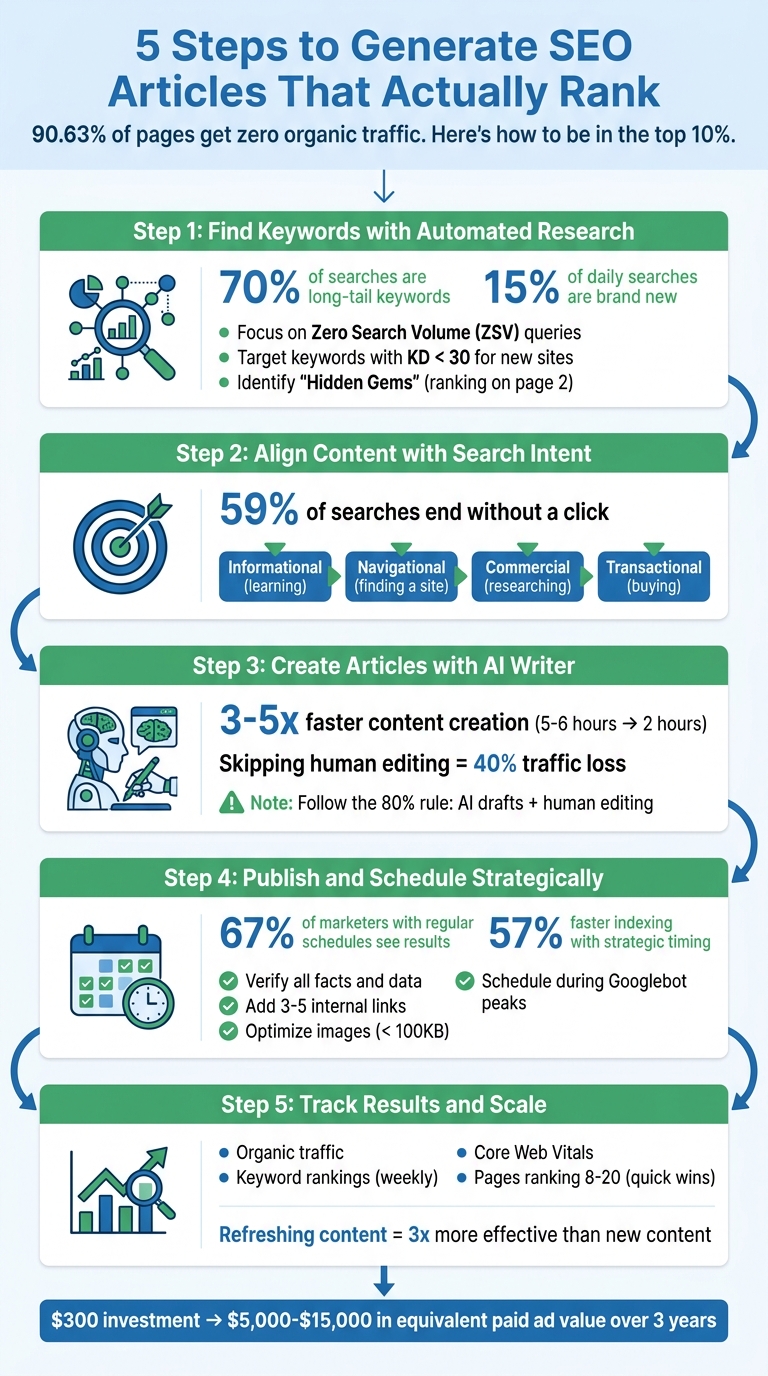 {5-Step SEO Article Creation Process for Higher Rankings}
:::
{5-Step SEO Article Creation Process for Higher Rankings}
:::
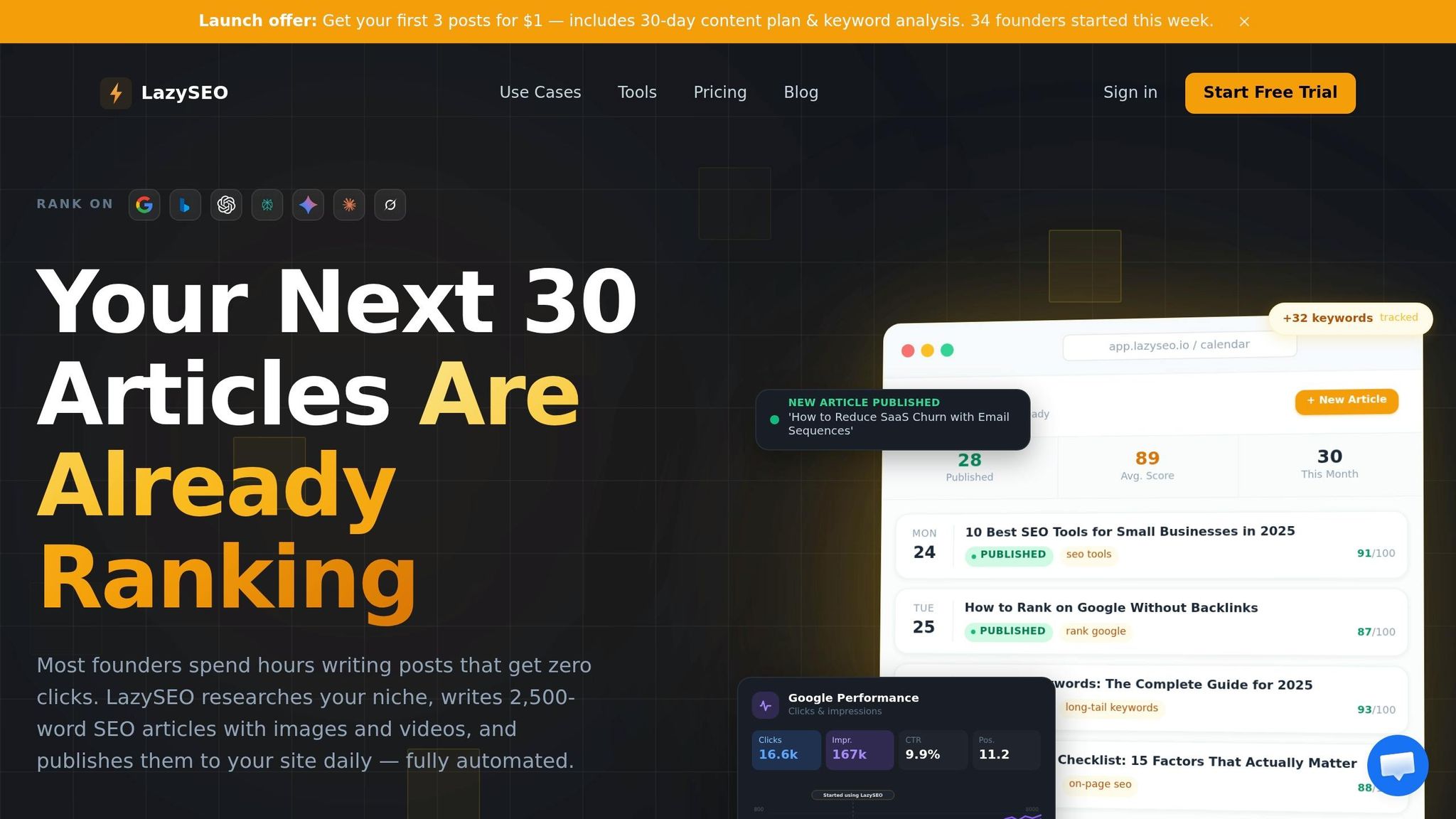
Step 1: Find Keywords with LazySEO's Automated Research
Why Keyword Research Matters
Keyword research is the foundation of effective content creation. Every day, 15% of searches are brand new, with no prior data to guide them [7]. Guessing what your audience might search for simply isn’t enough. You need to know exactly what they’re typing - and what they hope to find.
Choosing the right keywords isn’t just about drawing traffic; it’s about attracting the right visitors. Long-tail keywords make up over 70% of all searches and drive 92% of the queries with strong purchase intent. For example, six-word searches convert at 1.94%, while one-word searches convert at just 0.17% [12]. By focusing on specific, intent-driven phrases, you’ll get better results than chasing high-volume, generic terms.
AI is also reshaping search behavior. AI Overviews now appear in 47% of searches [8]. This means you’re not just optimizing for traditional search results anymore - you’re also positioning your content to be referenced by AI tools like ChatGPT and Perplexity.
Now, let’s dive into how LazySEO simplifies this process.
How to Use LazySEO for Keyword Research
LazySEO takes a smarter approach to keyword research by using semantic analysis and query patterns rather than relying on outdated database lookups [7]. The platform groups related keywords by their meaning and intent, building a "topical map" that signals expertise to search engines [7][8]. This map becomes the blueprint for your content strategy, ensuring you align with search intent from the start.
One standout feature of LazySEO is its focus on "Zero Search Volume" (ZSV) long-tail queries. These are often overlooked by competitors but can be found in niche spaces like Reddit discussions, customer support logs, and Perplexity’s Related Questions feature [7]. These untapped opportunities allow you to target highly specific queries that others miss.
LazySEO also identifies "Hidden Gems" - keywords where you’re already ranking on page two but lack a dedicated page to boost your position. By analyzing Google Search Console data with regex filters, the platform helps you spot these quick-win opportunities [7].
To top it off, LazySEO calculates Relative Keyword Difficulty, evaluating competition based on your site’s current authority [8][10]. For newer websites, it recommends targeting long-tail keywords with a Keyword Difficulty (KD) score under 30 [11]. It also categorizes keywords by intent - Informational, Navigational, Commercial, or Transactional - so your content aligns perfectly with what users are searching for [9][11].
sbb-itb-851db2b
Step 2: Align Content with Search Intent
What Search Intent Means
Search intent refers to the primary goal a user has when they type something into Google [13][15]. It's not just about the words they use but the reason behind their search. Google places a huge emphasis on satisfying this intent, often ranking pages higher when they align with what the user actually wants, even if keyword usage isn't perfect [15].
"Search engines do not rank pages based on keywords alone. They rank pages that satisfy intent."
There are four main types of search intent:
- Informational: The user wants to learn something (e.g., "how to bake sourdough bread").
- Navigational: They're looking for a specific website or brand (e.g., "Starbucks menu").
- Commercial investigation: They're researching before making a purchase (e.g., "best SEO tools") [13][14][15].
- Transactional: They're ready to take action, like buying or signing up (e.g., "buy running shoes online") [13][14].
Interestingly, about 59% of searches now end without a click because users often get answers directly from AI summaries or featured snippets [6]. If your content doesn't match the user's intent, it won't rank well. For example, in early 2026, the query "how to avoid AI detection" shifted from informational to navigational intent, leading to a drop in rankings for traditional how-to articles in favor of tool-based landing pages [14].
Tools like LazySEO analyze the top 10–30 search results to identify patterns in content type and structure [6][16]. By extracting heading hierarchies and spotting gaps in competitor content, it highlights opportunities you might otherwise miss [4][6]. This kind of automated SERP analysis helps you understand exactly what Google rewards, so you can create content that fits.
Understanding search intent is just the beginning. The next step is to structure your content in a way that directly addresses what users are looking for.
How to Structure Content for SEO
Once you've identified the right search intent, it's time to organize your content to meet those expectations. Start with a pyramid structure: deliver your main point or answer right at the beginning [6]. For informational searches, aim to provide a clear, concise answer in the first two sentences to increase your chances of appearing in featured snippets [15][6].
Use a logical heading hierarchy to guide readers and search engines alike. Stick to one H1 for your title, use H2s for main sections, and H3s or H4s for supporting details [17][6]. Framing headings as natural language questions can also help capture featured snippets [6][16]. Keep paragraphs short (1–3 sentences) and use bullet points, tables, and visuals to make your content easy to read and engaging [3][17][6].
Including an FAQ section with schema markup can add concise Q&A pairs that AI-driven tools might pull from [6]. While the average top-ranking page has around 1,447 words, it's more important to cover the topic thoroughly than to hit a specific word count [6].
"If users want product comparisons and you write a how-to guide, you'll never rank."
If your page has high impressions but low click-through rates or high bounce rates, revisit the SERP to ensure your content format aligns with what users expect [16]. A great example is from 2025, when Ahrefs reported a 516% jump in organic traffic for a landing page after adjusting its structure to align with the "3 C's" of search intent found in the SERPs [15].
Step 3: Create Articles with LazySEO's AI Writer
Why Use AI for SEO Content
AI-driven tools have reshaped how SEO articles are written. Tasks that once took 5–6 hours, like crafting a 2,000-word article, can now be completed in about 2 hours with AI assistance - a productivity boost of 3x to 5x [18][23]. While AI handles repetitive tasks like drafting and creating outlines, you can focus on more critical aspects like keyword strategy, fact-checking, and adding the insights that make your content stand out [18].
These tools are designed to analyze top-ranking pages, identifying the terms and structures that perform well with search engines [22]. Instead of outdated practices like keyword stuffing, AI places essential keywords naturally in impactful areas - titles, the first 100 words, and subheadings [19][20]. It also ensures your content is formatted with clear headings, bullet points, numbered lists, and tables, which search engines often favor for featured snippets [20][21].
By 2026, 83% of content teams using AI reported publishing more frequently, but less than one-third felt the quality had improved [24]. Skipping human editing can cost AI-generated content up to 40% of its potential organic traffic within 90 days. This highlights the importance of the "80% rule": the quality of AI output depends heavily on the details and constraints set in your content brief [24].
How to Generate Articles with LazySEO
LazySEO's AI Writer turns your research into optimized content with ease. Once your keyword and intent strategy is ready, the platform simplifies the content creation process.
Start by identifying your target keywords through automated research. LazySEO's SERP analysis then determines the type of content search engines prefer. Instead of generating an entire article at once, it creates content section by section. This approach minimizes repetitive or generic writing and keeps each part of the article focused [23][24].
Here’s an effective workflow: Begin your content brief by setting specific guidelines - such as avoiding overused phrases like "in today's digital landscape" - to refine the AI's output [18][24]. Generate a draft, but consider skipping the introductory paragraph, which is often generic. Starting with the second paragraph can give your article a stronger opening [24]. Always double-check facts; AI tools can sometimes fabricate data, so verify statistics, quotes, and URLs against reliable sources [23][24].
Finally, add elements AI can't replicate, like your personal experiences, unique insights, or original data. This not only enhances your article but also aligns with Google's E-E-A-T framework, which values expertise and authenticity [18][23].
"AI doesn't replace the writer - it replaces the blank page." – SimilarLabs [23]
Once your article is polished and fact-checked, use LazySEO's auto-publish feature to connect directly to your CMS. This eliminates the hassle of manual copy-pasting. You can also schedule posts with the built-in content calendar, ensuring consistent updates to your site. LazySEO integrates seamlessly with platforms like WordPress, Webflow, Ghost, Framer, and Shopify, making it simple to keep your publishing on track.
Step 4: Publish and Schedule with LazySEO
Final SEO Checks Before Publishing
Before hitting "publish", it's essential to run a thorough SEO quality check. Start by ensuring your primary keyword is strategically placed in key areas like the title tag, H1, the first 100 words, and at least one H2 heading [25][26]. Keep your meta description concise - under 155 characters - and include a clear call-to-action. Your URL slug should also be short and packed with relevant keywords [18][25].
Accuracy is non-negotiable. AI tools can sometimes generate incorrect statistics or claims, so manually verify all data, quotes, and links against trusted sources [18][24]. Add 3–5 internal links to related content and apply relevant schema markup (such as FAQ, HowTo, or Article) to improve indexing. This can even boost click-through rates by 20–30% [25].
Content structure plays a big role in readability and SEO. Aim for a Flesch–Kincaid grade level between 7 and 9 for B2B audiences. Use short, digestible paragraphs and a clear heading hierarchy (H1, H2, H3) to guide readers and search engines alike [24][26]. To increase your chances of being cited in Google AI Overviews, include a 40–60 word direct answer to your main topic in the opening paragraph [26]. Additionally, compress images to under 100KB using formats like WebP or AVIF, and write alt text that naturally incorporates keywords [23][26].
Here’s a real-world example: A B2B SaaS client streamlined 340 blog posts into 95 optimized pages using an 11-step process. The result? A 187% increase in organic traffic in just 90 days and a 312% boost in organic leads over six months [26].
"Publishing without a post-publish process is like opening a store and never turning on the lights. The inventory is there, but nobody can find it." – The SEO Engine Editorial Team [25]
Once these steps are complete, you’re ready to schedule your content for optimal indexing.
How to Schedule Content with LazySEO
After completing your final checks, it's time to schedule your content for maximum visibility. LazySEO makes this easy with its integrated CMS connection, allowing you to auto-publish while ensuring all your SEO signals are intact [23][27].
But timing matters. Instead of picking random dates, use Google Search Console (Settings > Crawl Stats) to identify when Googlebot activity peaks. Schedule high-priority content 24–48 hours before these spikes to significantly reduce your time-to-index - by as much as 57% [28]. For a more strategic approach, publish content in clusters. For instance, release a pillar page followed by 3–5 related articles within a 7–10 day window to establish topical authority [28].
Consistency is key. Data shows that 67% of marketers who stick to a regular publishing schedule see strong results, compared to just 24% of those who publish sporadically [28]. LazySEO Pro simplifies this with its capacity to handle up to 30 SEO-optimized articles per month, ensuring your team stays on track without feeling overwhelmed. Set a 90-day review date for every post to check rankings and make updates before the content loses relevance [25]. Dedicate about 20% of your publishing schedule to refreshing existing content, especially posts ranking in positions 4–10. Moving a post from position 11 to position 8 can multiply click-through rates by 3–5x [28].
"Publishing frequency isn't a strategy - it's a variable. The teams that grow fastest aren't the ones who publish most; they're the ones whose SEO content schedule matches their domain's ability to absorb and rank new pages." – The SEO Engine Editorial Team [28]
Step 5: Track Results and Scale Your Content
Which Metrics to Track
After publishing your articles, the next step is to track metrics that show how they’re performing. Start by focusing on organic traffic (visits from search engines), keyword rankings (your position in search results), and impressions (how often your content appears in searches) [3].
Pay attention to user behavior signals like bounce rate, dwell time (how long visitors stay on your page), and pages per session. These metrics reveal whether your content is meeting user expectations. For instance, if your page takes 2 seconds to load, the bounce rate is around 9%, but if it takes 5 seconds, it jumps to 38% [3]. Also, keep an eye on technical metrics like Core Web Vitals (LCP, INP, CLS), as they directly affect both rankings and user experience [3].
Tools like Google Search Console can help you spot keywords with high impressions but low clicks - ideal candidates for optimization [30]. Check keyword rankings weekly to identify trends while avoiding overreacting to daily fluctuations [29]. Keep in mind that SEO changes can take weeks or even months to show results in search rankings [30].
| Metric Type | Key Indicators | Primary Tools |
|---|---|---|
| Visibility | Rankings, Impressions, Market Share | Google Search Console, Ahrefs, SEMrush |
| Engagement | CTR, Bounce Rate, Dwell Time | Google Analytics, Search Console |
| Technical | Page Speed, Core Web Vitals, Indexing | PageSpeed Insights, Search Console |
| Authority | Backlinks, Social Shares, Mentions | Moz, Ahrefs, Social Analytics |
Every six months, conduct a content audit to refresh outdated content, update keywords, and fix broken links [2]. Pay special attention to pages ranking in positions 8–20. These pages often have the potential to move to page one within 30–60 days with some targeted updates [33]. Additionally, track whether your content is being referenced in AI Overviews, as these articles often provide more factual depth than those that aren’t cited [31].
By analyzing these metrics, you can identify areas for improvement and use automation to scale your content strategy effectively.
Scaling with LazySEO Pro
The data you gather from tracking metrics can guide how you scale your content production. Tools like LazySEO Pro streamline the process, reducing the time it takes to create a 2,000-word article from 5–6 hours to about 2 hours. Its AI writer can produce optimized drafts in under 20 minutes [18][32].
For $39/month, the Pro plan offers 30 SEO-optimized articles per month, including features like automated keyword research, SERP analysis, internal linking, and even auto-publishing to your CMS. This makes it easier to build topic clusters - interconnected pages revolving around high-traffic content - to establish authority faster.
"AI can scale output, but people still shape the value." – Arta Cheung, SEO consultant [31]
A case study from September 2025 illustrates this approach. By adopting an end-to-end AI workflow, a site shifted from producing 6–8 posts per month to using a clustered model of pillar and supporting content. Over 90 days, this strategy led to a 110% boost in organic traffic and improved the site’s median ranking position from 32 to 12 [5]. Features like "Auto-Optimize" and "Insert Facts" also streamline the process by enriching content with relevant data, cutting down on manual editing time [31].
While scaling, it’s crucial to track organic conversions alongside traffic to ensure your content delivers measurable business results [32]. Keeping an eye on citation rates in AI Overviews can also help maintain visibility in zero-click searches [31]. With LazySEO Pro’s content calendar and scheduling tools, you can maintain a steady publishing rhythm while ensuring quality through automated tools and human oversight.
A Complete SEO Content Strategy For 2026 (From Idea to Publishing)
::: @iframe https://www.youtube.com/embed/ZrnBUM4F2mA :::
Conclusion
Ranking SEO articles successfully comes down to following a clear and effective process. Start with low-competition keyword research (aim for difficulty under 40) rather than chasing high-volume, generic terms that are tough to rank for [1]. Make sure your content aligns with searcher intent and matches the formats Google tends to favor [6][1].
Leverage AI tools to speed up drafting - you can save 3–5x the time - but dedicate 20–40% of your workflow to human editing. This ensures precision and keeps your content authentic [23]. Before publishing, focus on on-page optimization by refining title tags and adding internal links. These are essential ranking signals that shouldn’t be overlooked [1]. Lastly, keep an eye on your performance metrics and update existing content every 6–12 months. Refreshing older articles can be up to three times more effective than constantly starting from scratch [1].
"Process beats talent, consistency beats intensity, and measurement beats intuition. Build the system first. The content follows." - Editorial Team, The SEO Engine [1]
For those looking to streamline this process, LazySEO offers a fully automated platform. At just $39/month, you’ll get 30 SEO-optimized articles complete with automated SERP analysis, internal linking, and scheduling. This cuts production time per article from 4–7 hours to just 2–3.5 hours [1]. Plus, you can try the system for a full 7 days for only $1, letting you experience how automation can transform your content strategy without compromising quality.
With AI-powered search on the rise, optimizing for both traditional rankings and AI Overviews is more important than ever. Cited content in AI Overviews can see a traffic boost of up to 35% [34]. By implementing an automated content system now, you can build a steady, long-term stream of organic traffic that continues to grow over time.
FAQs
::: faq
How do I pick a keyword that’s actually worth targeting?
To pick a keyword that’s worth your time, focus on how relevant it is, its potential to rank well, and the intent behind it. Begin with solid keyword research, then dig into details like search volume, competition level, and how it ties into your business goals. Make sure the keyword fits what your audience is looking for - whether they’re seeking information, ready to make a purchase, or navigating to a specific site. Stick to keywords that are realistic to target, relevant to your content, and aligned with user intent to improve rankings and bring in the right kind of traffic. :::
::: faq
How can I tell what search intent Google expects for my query?
To figure out the search intent Google associates with your target keywords, take a close look at the top-ranking pages. Are users looking for information, trying to navigate to a specific site, ready to make a purchase, or conducting a commercial investigation before buying?
Dive into keyword research, explore related terms, and study how competitors organize their content. Aligning your content with what users are searching for makes it more relevant and boosts its chances of ranking higher. :::
::: faq
How long should I wait before updating a new SEO article?
It's usually a good idea to wait 3 to 6 months before making updates to a new SEO article. This timeframe gives you enough data to evaluate how it's performing in terms of rankings and traffic. Around the 3-month mark, you can make small tweaks, like refining keywords or updating minor details. Save bigger changes, like restructuring or adding new sections, for closer to 6 months - especially if the content isn't fully meeting search intent or delivering the results you expected. :::