Low Traffic Problem: 6 Solutions for Small Businesses
Your website isn't getting enough visitors? You're not alone - 35% of small businesses struggle with generating traffic and leads, and 46% of SMBs with 11–100 employees report recent traffic declines. But there’s good news: you can fix this without a big budget. Here’s how:
- Automate Keyword Research: Tools like LazySEO save time by finding low-competition keywords and grouping them into clusters for better rankings.
- Publish SEO-Optimized Articles: Automated platforms help create high-quality content that ranks on search engines and drives visits.
- Stick to a Content Calendar: Regular publishing boosts search engine visibility and keeps traffic steady.
- Analyze Competitors: SERP analysis uncovers weaknesses in competitor strategies and identifies keywords you can rank for.
- Use Multimedia & Multilingual Content: Adding visuals and creating content in multiple languages attracts more users and keeps them engaged.
- Track SEO & Automate Publishing: Monitor performance and use tools to publish content consistently without manual effort.
Each of these strategies is practical, affordable, and proven to help small businesses grow website traffic. Check out our [SEO blog] for more tips. Let’s dive into the details.
::: @figure 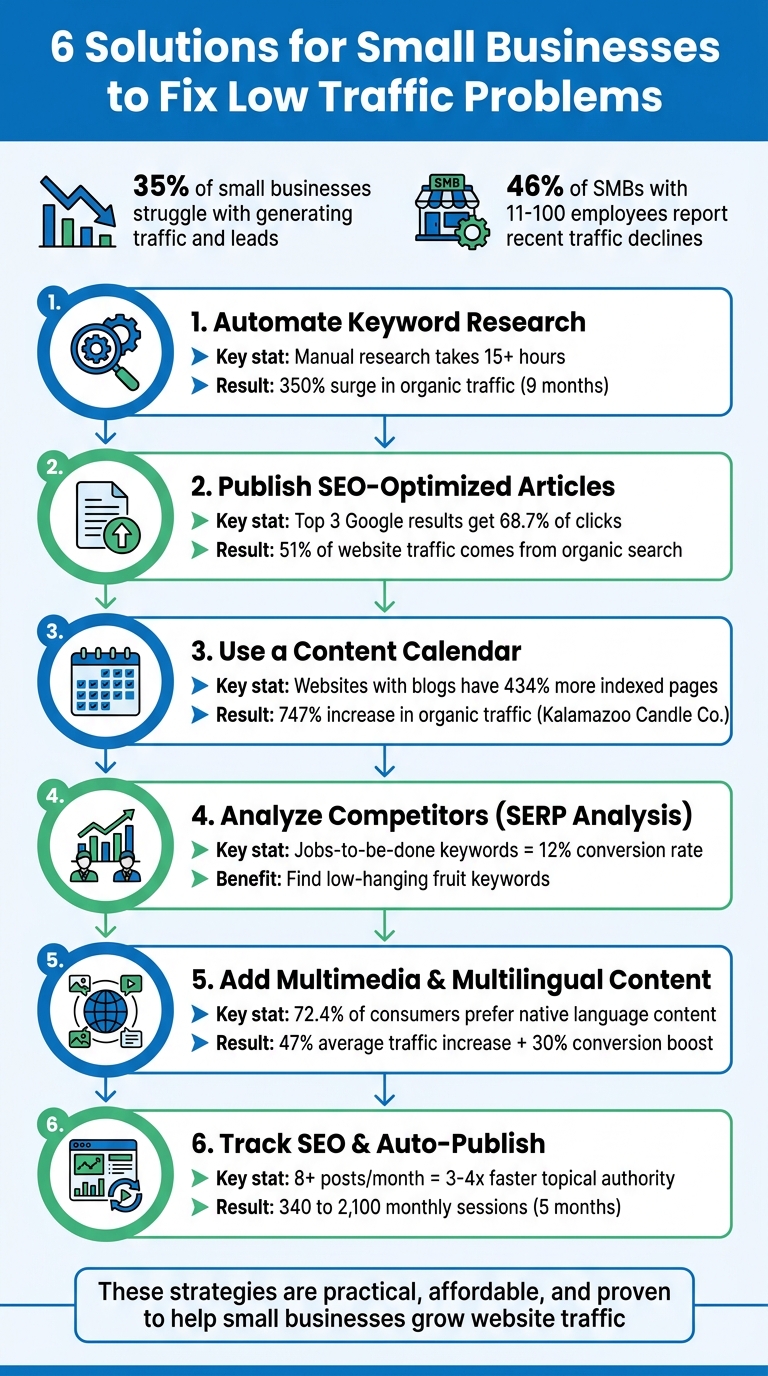 {6 Solutions to Fix Low Website Traffic for Small Businesses}
:::
{6 Solutions to Fix Low Website Traffic for Small Businesses}
:::
Solution 1: Use LazySEO to Automate Keyword Research
Why Keyword Research Matters
Keyword research is the backbone of driving the right audience to your website. Without it, your content lacks focus, making it harder to reach potential customers [5]. Businesses that align their content strategies with keyword research often see 3 to 5 times more organic traffic - and this traffic is more likely to convert [5].
The right keywords act as a bridge, connecting you with people actively searching for your product or service. High-intent keywords, in particular, target users ready to take action, whether that's making a purchase or reaching out for more information. A great example of this is SimplyThrilled, a video production agency led by CEO Jack Delaney. By implementing a focused keyword strategy in 2025, they went from receiving just a few inquiries per month to 4–5 inquiries daily [3]. This kind of growth underscores the difference between a static website and one that actively drives business.
But here’s the catch - manual keyword research is incredibly time-consuming. It can take over 15 hours to sift through data and identify the right opportunities [6]. For small businesses with limited resources, this is a luxury they often can’t afford. That’s where automation can make all the difference.
How LazySEO Makes Keyword Research Easier
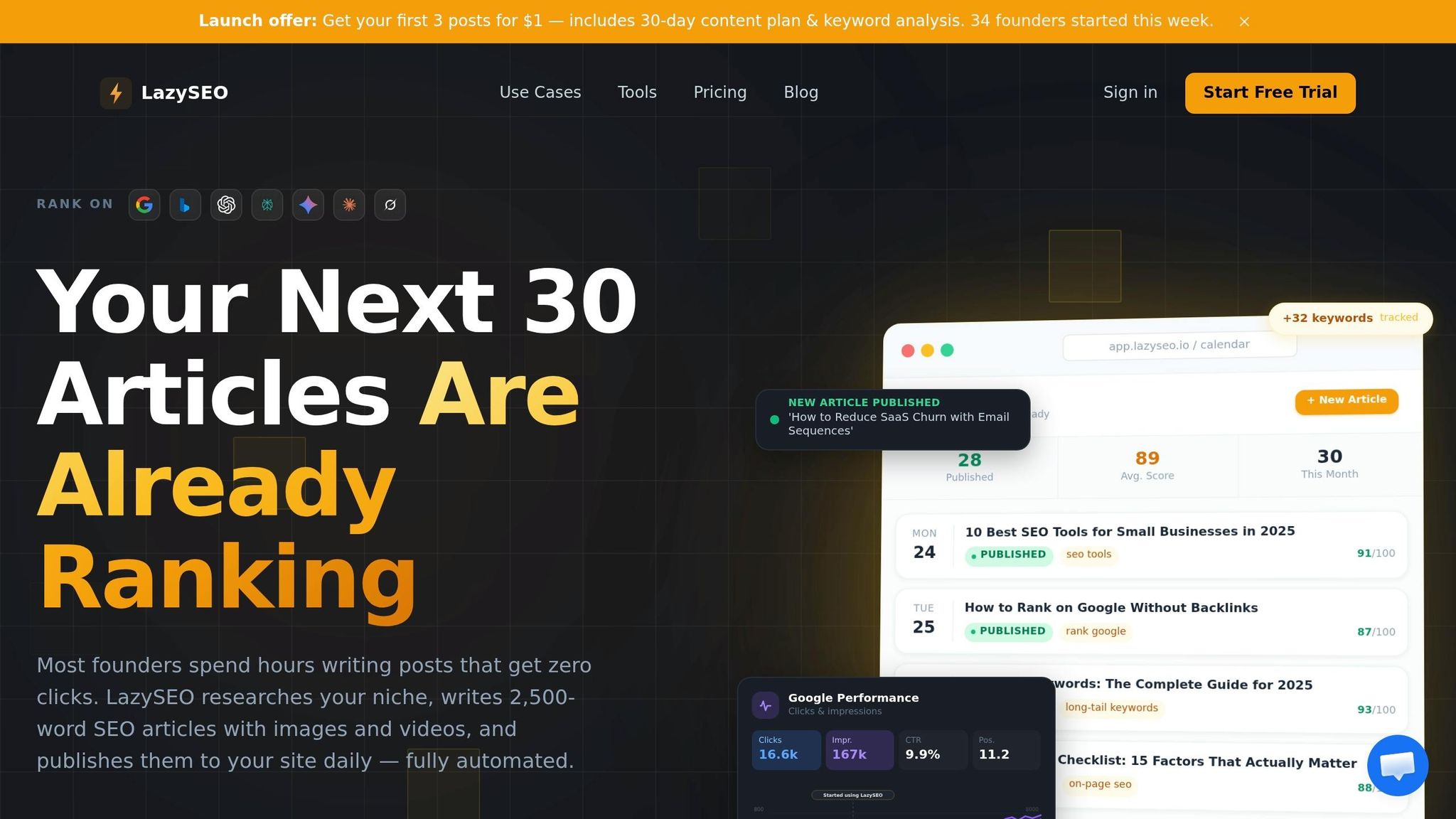
LazySEO simplifies keyword research by automating the entire process. It evaluates over 50 technical SEO factors, including competitor analysis and keyword clustering, to uncover niche-specific terms that are easier to rank for [3]. This automation saves you hours of manual labor while delivering actionable insights [3].
What sets LazySEO apart is its ability to pinpoint "weak spots" - low-competition keywords that others tend to overlook [6]. By grouping related keywords into clusters, the platform helps you establish topical authority rather than just chasing individual rankings [3]. It even identifies keywords that boost your visibility in AI search engines like ChatGPT, Gemini, and Perplexity [3], which is becoming increasingly important as search evolves.
The impact of LazySEO is clear. One B2B company saw a 350% surge in organic traffic within just 9 months by leveraging these automated strategies [3]. Similarly, Amuse, a manufacturing company led by CEO Gowri, used LazySEO to refine their SEO and content approach, leading to a 30% increase in custom parts inquiries from ideal B2B clients [3]. As SEO expert Britney Muller puts it:
We were successful because we listened to the keyword data [4].
sbb-itb-851db2b
Solution 2: Create SEO-Optimized Articles Automatically
Why SEO-Optimized Content Works
Organic search is a powerhouse for driving website traffic, accounting for 51% of all visits [8]. When your content is optimized for search engines, it ranks higher, making it easier for people to find you. Here's the kicker: the top three Google results snag 68.7% of all clicks [11]. If you're not on that first page, your chances of being noticed drop dramatically.
But the perks of SEO-optimized content go beyond just traffic spikes. Unlike paid ads, which stop generating clicks as soon as the budget runs out, well-optimized articles can keep pulling in visitors for months - or even years [10]. For example, small businesses that publish two or more SEO-friendly blog posts weekly see 3.5 times more organic traffic growth over a year compared to those who only manage one post a month [11]. The problem? Writing quality content at this pace is tough. Crafting a single blog post can take anywhere from 4 to 8 hours [9].
This is where automation comes in. Take the example of a project management SaaS startup in 2025. By automating SEO content creation, they targeted 120 high-intent keywords and ramped up their publishing rate from 2 to 12 posts per month. With just 15 minutes of review time per draft, their organic traffic jumped from 800 to 12,400 monthly visitors in six months [9]. Similarly, a landscaping company went from publishing one post a month manually to eight AI-assisted posts monthly, skyrocketing their organic traffic from 340 to 2,100 sessions in just five months [12]. These examples make it clear: automation is a game-changer.
How LazySEO Automates Content Creation
LazySEO takes the hassle out of content creation by automating the entire process. From identifying the right keywords to hitting "publish", this platform eliminates the time-consuming steps that slow you down [11]. Using AI, LazySEO analyzes search trends and generates keyword-optimized articles that stick to SEO best practices [11].
One standout feature is LazySEO's automated publishing pipeline. It doesn't just create content - it posts it directly to your site on a regular schedule. This ensures you always have fresh material going live, which signals search engines that your site is active and relevant. These systems run around the clock, building momentum for your rankings [7]. LazySEO even monitors how your content performs, flagging underwhelming posts and suggesting improvements to boost their rankings. With this kind of automation, businesses can go from having no content to publishing over 100 articles in less than three months - a feat that would take a single writer nearly a year [11].
The cost? LazySEO's Pro plan is just $39/month, delivering 30 SEO-optimized articles automatically. Compare that to hiring a freelance writer or maintaining an in-house SEO team, and the savings are hard to ignore [9].
Solution 3: Use a Content Calendar for Regular Publishing
Why Regular Content Updates Help
Search engines pay close attention to active websites. Publishing new content regularly encourages Google's crawlers to visit your site more often, which helps new pages get indexed faster and increases your chances of ranking [13]. Essentially, every new article creates another opportunity for your site to be discovered. In fact, websites with active blogs boast 434% more indexed pages compared to static sites [13].
The data backs this up. Companies that stick to a consistent publishing schedule often see noticeable traffic growth [13]. On the flip side, about 33% of blog posts start losing traffic within six months if fresh content isn’t added consistently [13]. That’s why having a structured plan is crucial to maintaining and growing traffic, as demonstrated by LazySEO's approach.
Take Kalamazoo Candle Company as an example. Between April 2022 and July 2024, they published around 81 weekly SEO-focused articles under the guidance of owner Adam McFarlin. This effort led to an impressive 747% increase in organic traffic, jumping from under 2,000 to 16,945 monthly visitors [13]. McFarlin shared:
We don't have to spend money on Google ads because of the work that Amanda is doing with Search Engine Optimization [13].
This kind of success isn’t the result of random posts here and there - it’s the outcome of a well-planned, consistent strategy.
How LazySEO's Content Calendar Works
To make consistent publishing easier, LazySEO offers a content calendar designed to simplify the process. It eliminates the guesswork by identifying trending topics and high-value keywords in your niche, then schedules articles to go live during peak audience times [14]. This ensures a steady flow of ready-to-publish content.
The calendar integrates seamlessly with platforms like WordPress, Webflow, Ghost, Framer, and Shopify, automatically pushing drafts into your publishing queue [14]. With the Pro plan priced at $39/month, you’ll get 30 SEO-optimized articles scheduled and published for you. The system even uses data from Google Search Console to analyze your site's crawl patterns and times posts to go live 24–48 hours before expected "crawl spikes", cutting your time-to-index by 57% [15].
Solution 4: Use SERP Analysis to Beat Competitors
What SERP Analysis Is
SERP analysis goes beyond basic keyword research. It dives into search results to uncover competitors' strengths and weaknesses, helping you spot opportunities others might miss.
At its core, SERP analysis is about examining the search results for a specific keyword. This process helps you understand competitor strength, keyword difficulty, and the types of content Google prioritizes [16]. By studying the top-ranking pages, you can figure out what works and why.
One major benefit is identifying low-hanging fruit - keywords where weaker pages, like forums or user-generated content (UGC) sites, dominate the rankings [17]. For instance, if Reddit or Quora appears in the top 10 for a keyword related to your business, it’s a golden opportunity. These platforms rely on UGC, which means a well-written, professional article from your site can outrank them.
Another key insight from SERP analysis is understanding search intent. Creating content that doesn’t match what users are looking for - no matter how great it is - won’t help you rank [16][19]. For example, if the top results for "best accounting software" are comparison articles rather than product pages, it’s clear that searchers want informational content, not a sales pitch. By aligning your content with this intent, you increase your chances of ranking.
"The site that Google deems best at aligning with search intent and meeting user needs is the winner. Getting there is not just about speed or scale, but requires good insights into target audience behavior and competitive differentiators." - Maddy Osman, Founder, The Blogsmith [18]
SERP analysis also highlights opportunities to capture SERP features like Featured Snippets, "People Also Ask" boxes, and Local Packs [16][19]. These features can boost your visibility even if you’re not ranking first in the organic results. Targeting "jobs-to-be-done" keywords - terms people use to solve specific problems - can lead to conversion rates as high as 12%, compared to the under 2% rates of generic keywords [18].
This approach forms the basis for LazySEO’s automated SERP analysis.
How LazySEO Provides SERP Insights
LazySEO streamlines the process by automating the discovery of keyword gaps - keywords your competitors rank for but you don’t [20][19]. With just one click, LazySEO scans thousands of keywords, pinpointing the best opportunities for your business.
The platform identifies a "Weak Page" as one with a Domain Authority below 20 or a site relying on UGC, such as Reddit, Quora, or StackOverflow [17]. LazySEO flags a keyword as low-hanging fruit when more than three weak pages appear in the search results [17]. This makes it easier to find keywords where you can rank without needing an extensive backlink profile.
LazySEO also evaluates title matches - keywords where the top-ranking pages don’t include the exact keyword in their titles [17]. By creating a page with a matching title, you gain a competitive edge. Additionally, the platform checks domain age using WHOIS data to identify competitors with domains less than a year old [17]. If a new site can rank for a keyword, chances are your business can too.
Another feature is the extraction of "People Also Ask" questions from the SERP. These can be used as subheadings (H2/H3 tags) in your content to improve topical authority [17]. This ensures your content addresses all the questions searchers might have, not just the main keyword.
Together, these tools help you uncover realistic opportunities to boost your rankings.
| Feature | Traditional Keyword Research | SERP Analysis (LazySEO) |
|---|---|---|
| Primary Focus | Search volume and Keyword Difficulty (KD) | Identifying "Weak Pages" and competitor gaps |
| Speed | Manual checks can take hours or days | Automated analysis of thousands of keywords |
| Data Points | Volume, KD, CPC | DA, UGC Platforms, Title Match, WHOIS data |
| Goal | Find popular terms | Find "low-hanging fruit" you can realistically target |
Solution 5: Add Multimedia and Create Content in Multiple Languages
How Multimedia Increases Engagement
Want to make your site more engaging and appealing? Adding multimedia can help you do just that. It enhances your site’s visual charm, improves search engine visibility, and keeps users interested.
Google now includes video and image content directly in search results, including AI-generated answers and "Top Insights" sections [21]. A great example of this impact comes from October 2024 - when a Georgetown hotel saw a 104% increase in image appearances after optimizing visuals for SEO. Similarly, a Massachusetts resort and spa experienced an 871% jump in image search appearances and a 101% boost in image impressions [21]. According to Benu Aggarwal, Founder and President of Milestone Inc.:
Well-chosen featured images or videos significantly boost a website's click-through rate (CTR) and encourage user engagement [21].
But it’s not just about adding visuals - it’s about making them work well. Optimize your images and videos for speed by using next-gen formats, lazy loading, and descriptive alt text. This ensures high-quality visuals won’t slow down your site. Aim for a Largest Contentful Paint (LCP) of 2.5 seconds or less [23]. Since most users view multimedia on mobile devices, make sure your visuals display perfectly on smaller screens, too [21].
This approach doesn’t just captivate your local audience - it also sets the stage for reaching users worldwide.
How to Reach International Audiences
Creating multilingual content is a powerful way to expand your reach. English may dominate the internet, but only 25.9% of users speak it as their primary language. Moreover, 72.4% of consumers are more likely to buy when product information is available in their native language [24]. Multilingual content builds trust and can lead to an average 47% increase in traffic [24].
Take, for instance, the British fashion brand Represent. In December 2025, they launched a German version of their site (eu.representclo.com/de/) with localized calls to action and payment options. The results? Their organic traffic doubled, and conversions rose by 30% [22]. This success came from fully localizing the user experience - not just translating the words.
If manual translations feel overwhelming, tools like LazySEO’s multilingual content generation feature can simplify the process. It automatically creates SEO-optimized articles in multiple languages, making it easier to reach global markets. For the technical setup, consider using a subdirectory structure (e.g., example.com/es/ for Spanish) to consolidate your SEO authority. Don’t forget to implement hreflang tags so search engines can serve the right language version to the right audience [22][25]. Start by focusing on high-impact pages, such as your homepage, popular blog posts, and product pages, before expanding further.
Solution 6: Track SEO Quality and Auto-Publish Content
Why Tracking SEO Quality Matters
It's simple: you can't fix what you don't measure. Keeping an eye on key SEO metrics like keyword rankings and organic impressions helps you identify what's working and spot problems early. For instance, tweaking and updating an old blog post can sometimes push it up several positions in search results.
One of SEO's greatest strengths is its ability to deliver results long after you've stopped actively investing in it. However, many DIY SEO efforts fail within just 90 days because regular upkeep is often overlooked [12]. As The SEO Engine Editorial Team aptly states:
SEO isn't a task you complete - it's a function you run [12].
Regular tracking can also help you catch technical issues - like broken links (404 errors), server problems (5xx errors), or expired SSL certificates - before they start to hurt your rankings or drive visitors away [26]. By focusing on both leading indicators (like impressions in Google Search Console) and lagging indicators (like form submissions or phone calls), you get a well-rounded view of your SEO performance [12]. Dedicate at least four hours a week to SEO tasks, treating it like a must-attend client meeting. This consistent effort helps ensure your SEO system stays in top shape and lays the groundwork for automating content delivery, which is a cornerstone of LazySEO's approach.
How LazySEO's Auto-Publish Feature Works
Time is often the biggest hurdle when it comes to maintaining SEO momentum. That’s where LazySEO steps in, automating content publishing to save you hours. Consistent content creation is critical for driving traffic, but manual publishing can eat up 5–8 hours per post - a huge drain on your time [12]. LazySEO's auto-publish feature takes care of this by automatically posting optimized articles to your site, removing the need for manual uploads.
This automation transforms your role from "content creator" to "content editor", making it easier to stick to a regular publishing schedule without the daily grind. And the results speak volumes: websites that publish eight or more optimized posts every month build topical authority 3–4 times faster than those publishing just two posts [12]. Take, for example, a landscaping company highlighted by The SEO Engine. By switching from one manually published post per month to eight AI-assisted posts, they boosted their organic traffic from 340 to 2,100 monthly sessions in just five months [12].
LazySEO's Pro plan, priced at $39 per month, includes 30 SEO-optimized articles each month. It also offers automated keyword research, SERP analysis, and auto-publishing. Plus, it tracks your content's SEO quality score, helping you identify which pieces need fine-tuning and which are ready to climb the rankings.
How I'd Get Traffic to a New Website if I Had to Start Over (2026)
::: @iframe https://www.youtube.com/embed/Qs_p21vLp1A :::
Conclusion
Dealing with low website traffic can feel like an uphill battle, but it’s not insurmountable. By implementing six focused strategies - automated keyword research, SEO-friendly content creation, consistent publishing schedules, SERP analysis, engaging multimedia and multilingual content, and SEO quality tracking with auto-publishing - businesses can create a reliable framework for growing their online presence.
These approaches aren’t just theories; they’re supported by hard numbers. Organic search accounts for 51% of website traffic, with Google dominating at 92% of that share [2]. Interestingly, half of small businesses tackle SEO on their own, highlighting the growing demand for automation tools [1].
As Andrii Beze, SEO Specialist at Livepage, explains:
SEO promotion for small businesses builds a steady presence in search results, and it doesn't just 'switch off' when you decide to cut ad spend [10].
This is a key advantage over paid ads, which stop delivering results the moment the budget runs dry. On the other hand, well-optimized content continues to attract visitors over time. Affordable automation tools can help small businesses consistently produce high-quality, SEO-optimized content without breaking the bank.
The online world is constantly shifting. Currently, 40% of small businesses report traffic drops due to Google algorithm updates and AI-driven search changes, while 48% are exploring Generative Engine Optimization to stay visible on platforms like ChatGPT and Gemini [1]. Businesses that quickly adapt to these changes and leverage automation for consistent content production will be better equipped to maintain and grow their digital footprint. By embracing these tools, your business can stay ahead in this ever-changing digital environment.
FAQs
::: faq
How long does it take SEO to increase traffic?
SEO usually starts showing results within 4–6 months, but the most noticeable growth often happens between 7–12 months. How fast you see progress depends on several factors, including your website's age, its domain authority, and the level of competition in your niche. The key to success? Consistent effort and ongoing optimization - these are what drive measurable improvements over time. :::
::: faq
Which keywords should small businesses target first?
Small businesses need to zero in on keywords that directly connect to their products or services while solving customer problems. This means targeting niche-specific terms, using local search phrases that resonate with your community, and analyzing competitor strategies to stay competitive. By crafting high-quality content around these targeted keywords, you can boost your search rankings and draw in more organic traffic. These steps not only improve visibility but also help establish your authority, driving more visitors to your site over time. :::
::: faq
What should I track to know if SEO is working?
To gauge whether your SEO strategies are working, keep an eye on a few key metrics:
- Organic search traffic: This shows how many visitors are finding your site through search engines.
- Keyword rankings: Track where your target keywords rank in search results over time.
- Domain authority: A higher domain authority often correlates with better search engine performance.
- Backlinks from reputable sites: Quality backlinks signal to search engines that your content is trustworthy.
Additionally, check your site's indexing status and analyze how your content is performing. Together, these metrics provide a clear picture of whether your efforts are boosting visibility and bringing in more traffic. :::