SEO ranking factors are the signals search engines use to decide where your website appears in organic search results. In 2026, mastering these factors is essential to drive targeted traffic and beat tough Google competition. The harsh reality: nearly 75% of high-intent clicks go to just the top three organic listings. If your content isn’t there, it’s invisible.
You know the pain—hours tweaking pages, keyword research, outreach, only to watch competitors leapfrog you overnight. It’s frustrating when every blog or product page fights algorithm updates, shifting user preferences, and content saturation. The old “ranking factors” checklists don’t move the needle anymore. In 2026, the rules have changed—and if you don’t adapt, your organic traffic will stall.
What’s changed? SEO isn’t just backlinks and keywords. Search engines weigh human engagement, semantic understanding, and AI-driven content evaluation. The difference between #1 and falling off page one can hinge on overlooked factors like user intent, page interaction depth, and site speed on mobile browsers. It’s a brave new world—but not impossible to master.
This guide breaks down modern, data-backed SEO ranking factors you must know—and outdated tactics to drop. Clear, actionable insights for digital marketers, SEO specialists, and content creators. Ready to stop guessing and optimize with confidence? Let’s dive into why these factors matter more than ever—and how to seize the top spot.
Why SEO Ranking Factors Matter More Than Ever in 2026

SEO ranking factors can make or break your business in 2026. If your site isn’t aligned with what search engines value, you’re wasting budget and missing qualified traffic. No more set-it-and-forget-it strategies—search engines move the goalposts every year, and this year, the pace is relentless.
Studies show 75% of users never scroll past the first page. Ranking outside the top 10? You’re invisible. Adapt or your competitors eat your lunch.
How Have SEO Ranking Factors Changed in 2026?
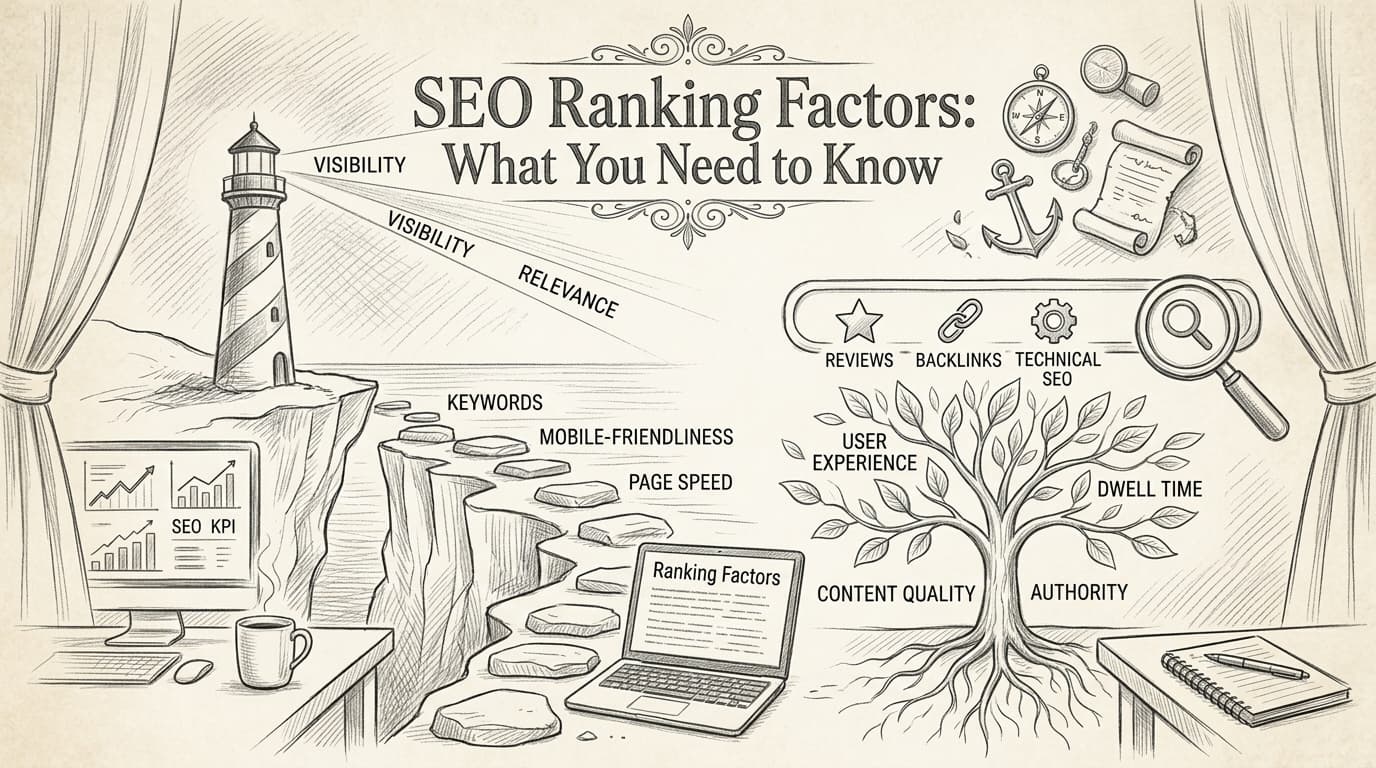
Keyword stuffing and a few backlinks won’t get you to page one anymore. Today, central ranking factors are:
- Content quality: Google’s AI spots fluff, filler, and clickbait. If your content doesn’t answer the query, you’re done.
- User experience (UX): Page speed, core web vitals, mobile responsiveness, and how easy your content is to read and interact with. Google wants satisfied users, not just keyword matches.
- Backlinks: Still important, but relevance and trust matter far more than volume.
- On-page SEO: Structured data, smart internal linking, title tags, and logical site structure are non-negotiable. A thorough technical SEO checklist helps meet these standards.
- Off-page signals: Social shares, mentions, and user engagement metrics feed Google’s AI-powered ranking engines.
Bottom line: If you haven’t audited your SEO since 2025, you’re leaving serious ROI on the table.
The Real Impact: Traffic Gains for Early Movers
Brands shifting from keyword-centric blogging to value-packed, user-focused content saw organic traffic climb 30% in under six months. These weren’t outliers—they aligned with how Google evaluates sites: intent, quality, and stickiness.
Imagine an article that answers every follow-up question versus one with keyword flashes. Depth keeps users and search engines coming back.
Why “Old-School” SEO Doesn’t Work Anymore
Clinging to thin content or replicating competitor backlinks wastes time. Google’s AI can differentiate expertise from content mills. Obsessing over tiny meta tag tweaks while ignoring UX or relevancy means focusing on the wrong levers.
Concrete Next Step: Run an SEO Audit
Check where you stand now:
- Crawl your site for technical issues slowing performance (broken links, bloated code, missing schema).
- Analyze top pages: Are they helpful, up-to-date, and mobile-friendly?
- Benchmark backlinks: Trustworthy, relevant, strong domains or outdated, low-value?
- Audit internal links: Logical structure matters for users and bots.
Anything “set and forget” likely holds you back.
SEO ranking factors gatekeep organic growth in 2026. Align with AI-driven priorities or get buried beneath better-optimized competitors. Start with a no-nonsense SEO audit.
For more on user behavior and ranking factor evolution, see 2026 SEMrush research.
What Are the Core SEO Ranking Factors in 2026?

Imagine a brand once owning page one for all key searches—steady traffic, leads flowing, revenue up. Fast forward to 2026, and those pages are buried, traffic tanks, leads dry up. This is the harsh reality after Google’s algorithm shifts left marketers scrambling to understand what moves the needle.
SEO ranking factors have never evolved faster. Relying on tactics from two years ago risks digital extinction.
What signals move rankings in 2026?
SEO is ruled by a few non-negotiables—ignore them and you’re invisible. First: content quality. In 2026, Google’s obsession is E-E-A-T: Experience, Expertise, Authoritativeness, and Trustworthiness. This model is baked into every core update.
Content must show real experience, feature experts, cite credible sources, and instill confidence—or it won’t rank. Niche B2B sites with expert guides outrank generic content farms, even with fewer backlinks. In a 2025 Search Engine Journal survey, 68% of marketers reported ranking drops after Google’s last update—mostly due to thin, untrustworthy content.
Are backlinks still critical?
Backlinks matter, but chasing hundreds of random links is a losing game. Quality rules. Google’s link analysis favors trust signals over numbers. One authoritative editorial mention from a respected industry site can outrank dozens of directory links.
Smart SEOs earn trust, not just votes. Spammy outreach or link wheels lead to irrelevance or penalties.
How critical is mobile optimization?
Over 70% of all searches are on mobile devices. Google enforces mobile-first indexing. If your site isn’t flawless on mobile—fast loading, easy navigation, readable fonts, tap-friendly buttons—forget top rankings.
Google’s crawlers check mobile first. Core Web Vitals are monitored on mobile performance. A decent desktop experience means nothing if mobile lags. Broken layouts or slow loading on iPhones or Androids cost visibility daily.
Which SEO factor has the biggest impact?
Content quality, backlinks, and mobile optimization form the critical trio. Don’t focus on one and ignore the others.
| Factor | Meaning in 2026 | Penalty for Ignoring | Example of "Doing It Right" |
|---|---|---|---|
| Content Quality | E-E-A-T content, real expertise, original data | Ranking loss, zero visibility | Expert guides, original industry stats |
| Backlinks | Few high-quality, relevant editorial links | Low authority, trust issues | Cited by major media or respected blogs |
| Mobile Optimization | Perfect mobile UX, fast load, high Core Web Vitals | Dropped from mobile results | Seamless on all devices, <2s load times |
Brands dominating search in 2026 balance all three—updating content, earning real links, and prioritizing mobile experience.
Don’t expect to stay on page one if you neglect these.
For more, see Google Search Central documentation.
How Does User Experience Impact SEO Rankings?
Google tracks over 300 ranking signals, up from 200 a few years ago. UX isn’t just on the list; it’s near the top. If your site frustrates, confuses, or bores users, your rankings suffer.
How UX signals influence SEO in 2026
UX shapes engagement metrics Google tracks—bounce rate, dwell time, and page speed. Visitors who quickly leave signal failure; those who stay and interact signal success.
UX can make or break your ranking. You can’t fake quality engagement—Google’s machine learning flags sites that disappoint users.
Five Most Influential UX Ranking Signals (2026)
| UX Metric | Description | SEO Impact | Benchmark |
|---|---|---|---|
| Page Speed | How fast content loads and becomes interactive | Fast sites rank higher; slow punished | <2s load for top 10 |
| Mobile Friendliness | Seamless on all devices | Mobile-first indexing drives SERPs | 100% responsive |
| Bounce Rate | % exiting after one page | High bounce lowers rankings | <40% preferred |
| Time on Site (Dwell) | How long users stay and engage | Longer time boosts trust | 2+ minutes ideal |
| Core Web Vitals | Google UX benchmarks (LCP, FID, CLS) | Meet thresholds or face demotion | 90+ score target |
Case Study: The Power of UX Overhaul
An e-commerce brand revamped their site—faster pages, intuitive navigation, fewer pop-ups. In three months, bounce rate dropped 20%, time on site doubled.
Result? Core category pages jumped from page two to top five for competitive terms. Reduced bounces and longer dwell time sent strong signals to Google.
Why Page Speed Still Rules (and Kills Conversions If Ignored)
Google data shows a one-second load delay can cut conversions by 7% (source). Speed impacts rankings and revenue. Heavy images or scripts cause traffic and revenue loss.
Action Plan: Optimize User Experience
- Test speed: Use Google PageSpeed Insights. Treat “yellow” or “red” scores as emergencies.
- Check mobile usability: Test on real Android and iOS devices.
- Improve navigation: Key content should be reachable in under three clicks.
- Track behavior: Use analytics (GA4, Hotjar) to monitor where users drop off.
- Prioritize Core Web Vitals: Optimize LCP, FID, and CLS on every update.
Tools like LazySEO help audit and prioritize UX fixes. Ignore UX, and you’ll slip off page one—no matter backlinks or meta tags.
On-Page vs Off-Page SEO: Which Matters More?
Both are essential for ranking in 2026. Which moves the needle more depends on your site’s strengths and weaknesses.
What’s the difference?
On-page SEO is what you control: meta tags, keyword placement, internal links, content quality, site architecture, and technical health.
Off-page SEO is trust earned outside your domain: backlinks, social signals, brand mentions, and citations.
Which impacts rankings more?
You need both. If your content is a mess, backlinks won’t save you. If on-page is solid but you lack backlinks, you’ll hit a ceiling.
On-page sets the stage. Off-page is the applause and endorsements.
New sites? Focus on on-page first—optimize content and fix technical issues. Established businesses breaking into competitive markets? Off-page backlinks from industry voices move the needle more than small on-page tweaks.
Real-World Scenario: Balancing Both
An e-commerce brand spent six months improving meta tags, product descriptions, site speed, and internal links. Rankings rose for low-competition keywords but stalled on big terms.
After a targeted outreach campaign earned high-authority backlinks, priority keywords jumped up to 19 positions. Off-page authority was the gas pedal once the foundation was ready.
When to prioritize each?
-
On-page needed if:
- Pages rarely hit top 20 regardless of backlinks
- Keyword cannibalization occurs
- Impressions flat, site slow or poorly optimized
-
Off-page needed if:
- On-page metrics are good but rankings plateau below page one
- Competitors outrank you with fewer but stronger backlinks
- Expanding into new markets or products
Key takeaway
Fix on-page SEO first if weak. Then focus on off-page—high-quality backlinks—to climb from page two to top three.
Ignore either and lose rankings. Build both systematically.
For more on authority beyond your site, see Moz’s off-page SEO guide.
How Emerging Technologies Are Shaping SEO
AI and voice search are reshaping SEO in 2026. Ignoring them means irrelevance as search intent evolves rapidly.
Search engines now interpret meaning. Models like BERT and MUM make Google more “human,” understanding nuance and context. Sites aligned with smarter search behavior leapfrog keyword-stuffers.
How AI is transforming search algorithms
AI prioritizes relevance and user satisfaction over tricks. BERT improved contextual understanding; MUM goes further—handling complex queries, analyzing images and language, surfacing nuanced results.
Example: “Best hiking boots for icy conditions in Sweden” returns reviews, forums, and product pages answering specifics. Old exact-match keyword content doesn’t compete.
Ranking is about solving user problems, not mentioning synonyms.
Authentic answers, depth, and structured info matter more than partial keyword coverage. Technical SEO without substance is dead on arrival.
Is voice search changing the game?
Yes—and fast. By 2026, over 55% of U.S. households own a smart speaker (Statista). Millions ask Alexa, Google, or Siri for recommendations, directions, and facts—in natural language.
Voice queries are longer and action-oriented (“Where’s the nearest 24-hour pharmacy?”), often hyper-local. Businesses prioritizing conversational content and FAQs see more “near me” traffic and capture local customers who never use a keyboard.
Example: A local HVAC company optimized for “Who installs air conditioners near me?” Their local map pack impressions jumped 38% year-over-year, driven by voice queries.
Voice search isn’t a side project. If your pages don’t match how people talk, you won’t surface how they search.
Actionable steps for future-proof SEO
Structured data isn’t optional. Schema markup helps search engines interpret content for rich results, featured snippets, and voice answers.
Adding schema to product pages, articles, and FAQs lets Google know you’re the definitive answer. Voice assistants pull answers directly from structured data.
Winners in 2026 use schema to signal authority, making themselves voice- and AI-ready.
Why AI and voice search shape SEO’s future
These technologies reward original, well-organized, context-rich content. Voice search punishes jargon and rewards clear, answer-focused writing.
Businesses embracing these shifts gain top positions; others watch competitors pass them.
If you’re not updating for AI and voice in 2026, your SEO will decay. Use structured data, write for real people, and keep pace with search’s direction.
Future-Proofing Your SEO Strategy for 2027 and Beyond
AI and voice search aren’t trends—they’re reshaping SEO. Clinging to 2023 tactics risks a visibility crisis.
The best way to future-proof? Relentless adaptation. Algorithms shift, user behaviors evolve, and brand signals rival backlinks in influence. Waiting until rankings tank to update is a rookie mistake.
What does “future-ready” SEO mean?
Continuously update your approach to match AI-driven algorithms, voice search, and rising user expectations. Strategies that win today won’t survive by 2027 if you treat SEO like a checklist.
Gartner projects voice searches at 40% of queries by end of 2026. Users run full purchase journeys by voice. Old tactics like keyword stuffing or link swapping don’t work here.
Why brand signals matter
Brand signals—branded searches, mentions, direct traffic, engagement—show trustworthiness and authority. Unlike classic factors, brand signals persist despite algorithm changes.
Too many marketers obsess over technical SEO while ignoring brand-building. Companies investing in brand between 2021-2025—like Notion or Duolingo—saw steady organic growth and survived algorithm updates wrecking weaker brands. Their visibility became algorithm-resistant.
When people search your brand, you’re less vulnerable to Google’s next shake-up. That’s a moat no keyword hack matches.
Old-School vs Modern SEO
| Factor | Old-School SEO (2023) | Modern SEO (2027-ready) |
|---|---|---|
| Search Intent | Text-based, “ten blue links” | Conversational, voice-first, AI chat |
| Content Optimization | Keyword density, metadata | Entity optimization, topical authority |
| Ranking Signals | Backlinks & exact match keywords | Brand signals, engagement, real reviews |
| Analytics Tools | Basic web analytics | AI/ML-powered user journey insights |
| User Experience | Desktop-optimized | Seamless mobile, voice, and AI |
| Site Authority | DA/PA, legacy backlinks | Topical & brand authority |
Success isn’t about doing more; it’s about doing smarter—and differently.
Building a brand that ranks (and stays ranked)
To get lasting SEO results, invest in your brand as much as content or outreach. Savvy teams:
- Track branded search volume: Use Google Search Console or Semrush to monitor company/product name searches. This shows SEO equity growth.
- Manage brand mentions: Respond to reviews, encourage discussions, track linked or unlinked mentions.
- Deliver consistent value: Across blog, YouTube, LinkedIn, and customer support to build trust and branded searches.
- Prioritize voice and mobile UX: Forget desktop-first. Customers search and convert without ever seeing your homepage.
How to stay ahead: Ongoing SEO health
SEO isn’t one-time—it’s monthly work. To future-proof:
- Review SEO data every 30 days. Use hard numbers, not hunches.
- Track algorithm updates and industry shifts. Subscribe to Google Search Central, SEO news, and trusted newsletters.
- Experiment with new SERP features and channels. Voice commerce, AI summaries, snippets aren’t future—they’re now.
- Revisit keywords quarterly. Voice and AI introduce new question formats. Use LazySEO's Keyword Research Tool to spot changes.
Marketers winning in 2027 obsess over adaptation. The past isn’t coming back, nor your old rankings if you coast.
For more on future trends, see Gartner report on voice and AI search.
Stay Ahead of the SEO Curve
The key: prioritize user experience—from page speed to engaging content. Search engines in 2026 reward real value more than ever. On-page and off-page factors both matter, but usability and relevance are foundations for top rankings. Embrace new tech and track evolving trends—what works today might change tomorrow. Tools like LazySEO help automate tracking and adapting to shifting SEO factors, so you’re never caught off guard. Keep experimenting, analyzing, and optimizing. Your best rankings are ahead—make your move now.