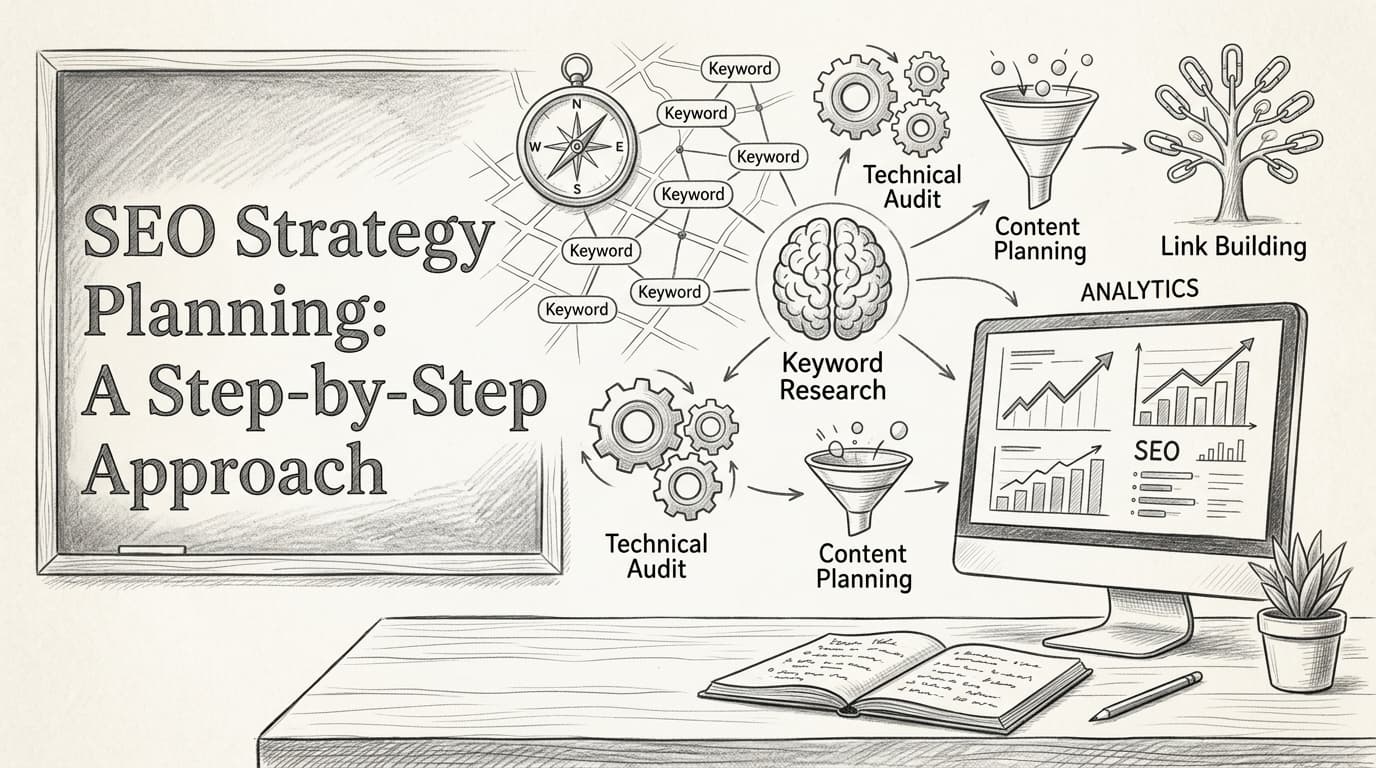
SEO strategy planning involves analyzing search opportunities, setting clear goals, and building a roadmap to grow organic traffic efficiently and predictably. In 2026, successful SEO strategy planning goes beyond keyword optimization. It means using AI-driven insights, understanding evolving search intent, and integrating every aspect of your digital marketing to outperform competitors. Without a proactive SEO strategy, even the best content gets buried on page two or worse.
You spend hours tweaking title tags, pushing out blog posts, hoping this will be the week your traffic turns a corner—only to see the same unimpressive line flatlining across your dashboard. Meanwhile, your competitors climb the rankings, raking in clicks and conversions you feel should be yours. You're not alone. Over 70% of marketers admit their SEO efforts are hampered by messy strategies and time-consuming keyword research. The frustration isn't just about low traffic; it's about wasted energy and lost opportunities.
The realities of SEO in 2026 are complex—and rewarding. Search algorithms shift monthly. User behaviors become harder to predict. AI-generated competitors now jostle for every position on the SERP. But with a clear, future-facing SEO strategy, you can dismantle the guesswork and build sustainable search growth, no matter how volatile the market gets. This guide empowers you with actionable frameworks, new research tactics, and the latest tools you'll need to stay ahead—not just today, but for years to come.
Why Is SEO Strategy Planning Crucial in 2026?

SEO strategy planning in 2026 isn’t optional—it’s essential for brands that want predictable, compounding growth. Over 70% of marketers agree: SEO delivers more sustainable results for long-term business health than PPC ever could (crobenchmark.com). Ignore SEO or treat it like a checklist, and you're just treading water while smarter competitors lap you.
Why Is Planning Your SEO Strategy More Critical Than Ever?
A properly executed SEO plan can spike your organic traffic by up to 150% in a single year. No paid campaign comes close. But you don’t get those results by publishing a couple of blog posts and hoping for the best. The businesses dominating search now have a precise, evolving roadmap and a daily routine that supports it (seo-day.de).
Bottom line: SEO strategy planning aligns keyword strategy, site architecture, technical routines, and content development so you consistently capture search demand, month after month.
How Has SEO Changed in 2026?
A few things you can’t ignore if you want to win:
- AI-driven ranking algorithms: Google and Bing now weigh engagement signals and topical authority more heavily. Thin, scattershot content gets buried.
- Entity SEO: Success hinges on mapping your content to entities and concepts that search engines understand, not just keywords.
- Automation & Scale: Manual research might cut it for a 5-page site. But with 100+ URLs, streamlining with an auto SEO platform is the only way to keep pace.
- Content quality trumps volume: 2026’s winners publish less, but every piece hits search intent precisely and is structurally optimized (siteimprove.com).
Real-World Example: SaaS Market Share Grab
A SaaS provider battling entrenched competitors shifted from scattered keyword targeting to a targeted, entity-driven SEO plan, capturing 30% more market share. They audited their strengths, identified weaknesses, and focused on topics where they could build topical authority. Within 12 months, organic sign-ups doubled, and monthly demo requests exploded.
What Should Your First Move Be?
Start with a brutally honest SWOT analysis for your SEO:
- Strengths: Where does your site already rank? Which pages are outperforming, and why?
- Weaknesses: Outdated blog content, site speed, technical gaps?
- Opportunities: What striking-distance keywords could deliver big if prioritized?
- Threats: Who’s eating your lunch on Page 1?
This clarity becomes your blueprint for deciding where to invest time, money, or automation.
How to Conduct Effective Keyword Research in 2026
Picture your competitor, once an afterthought, now leapfrogging your rankings. Their traffic’s surging—yours is a flatline. You dig into the data, only to realize that outdated SEO tactics and last year’s keyword lists can’t keep up with where search is heading.
You can’t afford to guess your way through keyword research anymore. Search algorithms are evolving faster than ever, and according to Gartner, 67% of marketers believe that Google’s search updates in 2025 significantly impacted their web traffic. Search engines are using AI models that anticipate search intent before a user has even finished typing.
Why Are AI-Driven Tools Now Essential for SEO Strategy Planning?
AI-driven keyword research tools are now the backbone of effective SEO. Only AI can keep pace with how quickly search intent changes and user behavior shifts. 60% of SEO specialists now rely on AI tools to surface keyword opportunities that their competitors are missing.
Traditional tools weren’t built for this. Legacy platforms like SEMrush and Ahrefs are still relevant, but their workflows can’t match the real-time adaptability of AI-powered systems.
What’s Different Between Traditional and AI-Driven Keyword Research?
Traditional keyword research is mostly manual—think keyword lists, volume checks, and generic competition scores. AI-driven tools interpret massive volumes of data to spotlight emerging trends, related entities, and intent shifts.
AI keyword research platforms (like Surfer SEO and Clearscope) tap into live search data and analyze competitor content, closing the gap between what people search for and what actually converts.
How Do You Implement an Effective Keyword Clustering Strategy?
Forget working with a messy, unstructured keyword dump. Keyword clustering groups related keywords by search intent and topic, making it easier to build content hubs and match user needs.
AI-driven platforms scan your master list, recognize semantic similarities, then organize terms into intelligent groups. Sites that use keyword clustering see compounding benefits: stronger topic authority, higher pages per session, reduced bounce rates, and more efficient content production.
Why Keyword Research in 2026 Demands New Approaches
Trying to outsmart AI-powered search with the same tired checklists is a losing bet. Everything about SEO strategy planning in 2026 points to automation, intent mapping, and smarter clustering.
Want to see what some of these new AI-driven good approaches look like in action? Siteimprove’s guide shows how modern tools and strategies are shaping content optimization in the new era of search.
What Are the Best Tools for SEO Strategy Planning?

Tools like SEMrush, Ahrefs, and Moz are essential for SEO strategy planning in 2026, thanks to advanced features for keyword analysis, competitive audits, and automated insights. These platforms help you stay ahead as search behavior pivots fast—especially with Comscore projecting that over half (55%) of all searches this year will be voice or image-based.
SEO isn’t just about keywords anymore. With multimodal queries—people searching by snapping photos, speaking into smart assistants, or blending text and imagery—your SEO software must go well beyond basic keyword tracking.
Why SEMrush, Ahrefs, and Moz Still Reign in 2026
SEMrush, Ahrefs, and Moz aren’t just "legacy" platforms—they’re the backbone of any serious SEO operation.
- SEMrush delivers standout competitor gap analysis, bulk SERP tracking, and content recommendations tailored for modern search intent.
- Ahrefs dominates for backlink analysis, but its intent-based keyword explorer and content gap tool make it indispensable for mapping search journeys beyond text.
- Moz has stayed relevant with robust on-page optimization and smart link-intersect tools, and recent upgrades tie directly into entity SEO and multimodal query metrics.
If you’re prepping strategies for e-commerce, SaaS, or enterprise-scale sites, you need more than superficial stats. These platforms offer API data pulls, automated site crawls, and entity SEO tracking.
What Features Actually Matter in SEO Tools Now?
Not all "auto SEO software" delivers the horsepower you need. You’ll want tools that handle:
- Voice and image keyword insights: Track new types of queries and filter by search intent.
- Entity SEO identification: Map your content around entities, not just vanilla keywords.
- Pagination SEO analysis: Diagnose crawl issues, indexation problems, and automate canonical fixes.
- Content scoring and opportunity finder: Real-time suggestions for topics and SERP gaps.
- API and integration: Connect your toolset so reporting, auditing, and site changes sync without manual work.
SEMrush vs Ahrefs vs Moz—Features and Pricing: What’s Best for You?
Forget thinking there’s a one-size-fits-all answer. Here’s how they line up for specific needs:
- Choose SEMrush if your workflow demands robust competitive intelligence, smart keyword intent classifiers, and multi-project dashboards.
- Go with Ahrefs if you prioritize deep link analysis, swift content gap discovery, and entity-first keyword research.
- Moz makes sense for those who want best-in-class on-site optimization features and a more approachable learning curve.
You’re fooling yourself if you think saving on tools is “lean strategic planning.” The real waste is burning hours on manual audits that automation solves—especially now that auto SEO platforms are affordable for mid-sized teams and updated for 2026’s search realities.
How to Upgrade Your SEO Toolset Right Now
You’ll stagnate if you stick with the same tools as last year. Here’s how to modernize, quickly:
- Audit your current toolkit: List your SEO tools and note where you still use manual processes or have data blind spots.
- Benchmark features: Check competitor toolsets—most agencies now use multi-tool stacks for overlapping feature coverage.
- Trial top platforms: Activate trials for SEMrush, Ahrefs, or Moz and run head-to-head keyword analysis, site audit, and auto-reporting tasks.
- Integrate at least one new, automation-first tool: Don’t just add for the sake of it—replace or upgrade where clear time savings and data depth appear.
- Train your team: Don’t skip onboarding! New features for entity SEO and multimodal analysis need focused upskilling.
The bottom line: investing in the right auto SEO platform accelerates your entire planning process—and in 2026, clinging to outdated tools is a fast track to being outperformed.
How Does Content Strategy Fit into SEO Planning?
Content strategy is the backbone of effective SEO planning. If your content isn’t mapped directly to your organic search goals, you’re leaving both traffic and revenue on the table.
Why Content Strategy Drives SEO Results
Content strategy isn’t that nebulous “let’s just blog a lot” approach. It’s an intentional, measurable framework that aligns your site’s articles, category pages, and even product descriptions to the real questions your audience is googling every day.
Websites that prioritize a unified content and SEO strategy see 2x more user engagement on key pages compared to those treating content as an afterthought (source).
Content vs. Other SEO Pillars: Where It Fits
Here’s where content sits next to other SEO priorities:
| SEO Pillar | Focus Area | Impact | Example Use Case |
|---|---|---|---|
| Keyword Strategy | Research & intent | Drives targeting; finds what searchers want | Identifying "auto seo software" queries |
| Content Strategy | Information & UX | Engages users; provides value; builds topical authority | Creating guides for SEO pagination |
| Site Architecture | Structure & crawl | Ensures accessibility and indexability | Implementing clean pagination SEO |
Content is what answers the user’s questions. Keyword strategy steers the ship, but content is the engine. Architecture keeps things running smoothly.
Real-World Example: E-Commerce Win with Content Optimization
An e-commerce brand lost in the noise saw traffic stalling, but product pages barely had any substance. By building out detailed buying guides, integrating reviews, and connecting FAQ-rich content to the main categories, conversions jumped 25% over a single quarter.
How to Align Content and SEO: A Practical Framework
The best way to connect your content with SEO goals? Build a living, breathing content calendar that incorporates target keywords, mapped directly to real search opportunities.
Steps to a content/SEO calendar that actually drives results:
-
Map Keyword Research to Content
Cross-reference your highest-potential keywords with planned content formats. -
Assign Each Content Piece an SEO Goal
Every calendar item should state the target keyword, search intent, target audience, and CTA. -
Schedule by Opportunity, Not Just Topic
Time your content releases to seasonality, competitor gaps, or search trend spikes. -
Measure & Adapt
Rely on analytics—not gut feelings—to double down on what’s working.
What Happens Without a Content Strategy?
If you don’t link your SEO and content strategy, you’ll end up chasing after rankings with thin, disconnected pages. Search engines notice. Users definitely notice. And engagement tanks.
Technical SEO: The Foundation of a Successful Strategy
Technical SEO makes or breaks your strategy—without it, even the best content can vanish from search results. Technical SEO ensures search engines can crawl and index your site, and if you ignore it, you’re basically locking the front door and asking Google to turn away.
Ever stare at a competitor outranking you despite their thinner, less helpful content? Odds are, technical SEO is the secret weapon. 80% of SEO issues aren’t about keywords or backlinks—they stem from technical snags like site speed, mobile optimization, crawl errors, and pagination SEO structure (siteimprove.com).
Why Technical SEO Is Non-Negotiable
You might obsess over blog topics and pillar pages, but if Google’s bots can’t reach the right pages, your efforts are wasted. Technical SEO covers things like site structure, crawlability, indexation, speed, mobile-friendliness, and even properly managing things like SEO pagination or canonicalization.
Ignoring these means you’re gambling with organic visibility. A slow, bloated site loses users and ranking potential. Just ask any major e-commerce retailer—one well-documented case slashed page load time by 50% and saw a 20% spike in organic traffic in less than a quarter.
Common Technical SEO Issues (And How to Fix Them)
Here’s where technical SEO can go sideways—and exactly what you can do about it:
| Issue | Impact | Solution |
|---|---|---|
| Slow Page Load Times | Lower rankings, higher bounce rates | Optimize images, use caching, use a CDN |
| Poor Mobile Optimization | Drops from mobile searches | Responsive design, prioritize mobile experience |
| Crawl Errors (404, 500) | Pages omitted from the index | Regularly check Search Console, fix or redirect broken URLs |
| Duplicate Content | Dilutes ranking signals, keyword issues | Set canonicals, use noindex where appropriate |
| Disorganized Site Structure | Crawl inefficiency, orphaned pages | Use clear navigation, minimize depth to key pages |
| SEO Pagination Errors | Missed content, index bloat | Use rel="next"/"prev" properly, consolidate with canonical tags |
| Missing XML Sitemap/Robots.txt | Hidden pages, blocked resources | Submit clean, updated versions to Google Search Console |
What Happens When You Get Technical SEO Right?
Here’s what separates brands that dominate organic search from everyone else: flawless technical execution. Sites that nail the fundamentals load in under 2 seconds, play nice with every device, and organize content logically.
A major national retailer is a textbook example. With thousands of SKUs, their site was plagued by slow load times and inefficient pagination SEO. By prioritizing performance audits and restructuring their navigation and auto SEO software setup, they cut page load times by half. The result? A 20% jump in organic visits.
Future-Proofing Your SEO Strategy for 2027 and Beyond
Staying updated with Google’s constant algorithm changes is the only way your SEO strategy survives the long haul. Ignore these shifts, and you’re on a fast track to irrelevance.
Some sites learn this lesson the hard way. A large SaaS platform’s blog was cruising with thousands of rankings—until the 2025 Core Web Vitals update. Overnight, traffic tanked 40%. The mistake? Prioritizing flashy design over foundational technical SEO. Once Core Web Vitals issues were fixed, the site didn’t just recover; its most valuable lead-gen pages reclaimed top-three spots within 60 days.
Why Is Staying Updated on Algorithm Changes Essential?
Google updates its algorithm over 500 times a year, reshaping the playing field every single week. Survive and thrive by future-proofing your SEO approach—adaptability isn’t optional.
How Do Leading Marketers Adapt to Algorithm Shifts?
Here’s how a content marketer at a major e-commerce brand stayed ahead. As 2025’s algorithm updates rolled out, most competitors scrambled. Instead, this marketer already had these future-proofing moves in place:
- Content mapped tightly to user intent, not old-school keyword stuffing.
- Routine Core Web Vitals audits, fixing mobile issues before they hit rankings.
- A lean technical SEO stack—automation limited manual errors.
- Real-time monitoring using an auto SEO software platform that flagged content at risk.
What Concrete Steps Should You Take to Stay Ahead?
You can’t predict every algorithm shift, but you can engineer resilience and speed into your SEO processes. Make these non-negotiable:
- Set up alerts for SEO news: Subscribe to Google’s Search Central Blog, industry updates, and Twitter accounts run by trusted SEO analysts.
- Schedule quarterly SEO audits: Go beyond content. Include Core Web Vitals, mobile UX, and entity SEO structures.
- Routinely test technical fixes: Address issues like pagination, crawl budgets, and structured data. Automate wherever possible with a leading auto SEO tool or platform.
- Track, measure, adapt: Use analytics to spot ranking or traffic dips the moment they happen.
Table: Core Future-Proofing Tactics—Manual vs. Automated Approaches
| Tactic | Manual Approach | Automated (Auto SEO Tool/Platform) |
|---|---|---|
| Core Web Vitals | Monthly audits, developer handoffs | Real-time issue detection, auto-suggested fixes |
| Algorithm Monitoring | Manually check industry news & blogs weekly | Automated Google update alerts, Slack integration |
| Pagination SEO | Developer manages tags/canonicals for each paginated series | Auto-detects pagination errors, proposes canonical strategies |
| Entity SEO | Manual schema markup, research entity gaps | AI-driven entity analysis and schema suggestion |
| Analytics Review | Custom dashboards, manual deep-dives | Automated anomaly alerts, prioritized action recommendations |
How Can You Prepare for Search in 2027?
Organic search will keep getting more unpredictable—AI-driven indexing, new content formats, tighter technical benchmarks. If you’re not baking adaptability into your SEO strategy planning now, you’re leaving the door wide open for faster, smarter competitors.
Set up continuous learning loops. Prioritize technical excellence alongside content depth. Automate wherever you can, but don’t hand over the strategy wheel completely to any tool—even the best auto SEO software can’t replace a sharp, data-savvy human.
Steady attention to trends, relentless technical hygiene, and a bias for action will keep your strategy ahead—no matter what Google throws at the industry next.
Make Every Click Count
SEO strategy planning in 2026 isn’t just about staying ahead—it’s about building a foundation that adapts and thrives as search evolves. The actionable takeaway? Prioritize a flexible, data-driven approach: revisit your keyword research regularly, align your content with user intent, and keep technical SEO airtight. As algorithms shift, your agility will set you apart. Tools like LazySEO can help streamline this process, making it easier to monitor trends and automate routine tasks. Stay proactive and keep your strategy future-focused—success belongs to those ready to adapt and lead the way into 2027 and beyond.