
SEO Automation vs Manual Content: Which Works Better?
Both SEO automation and manual content creation have their strengths, but the best approach depends on your goals and resources.
- SEO Automation: Great for speed and scale. Automates repetitive tasks like keyword research, content generation, and technical audits. It’s cost-effective and ideal for producing large volumes of content targeting low-competition keywords. However, it risks creating generic content and requires human editing to maintain quality.
- Manual Content: Focuses on quality and authority. Human-created content ranks higher, earns more backlinks, and has better traffic stability during algorithm updates. It’s best for competitive niches, YMYL topics (finance, health, legal), and content requiring expertise or storytelling. The downside? It’s slower and more expensive.
Quick Comparison
| Factor | SEO Automation | Manual Content |
|---|---|---|
| Speed | 3–5x faster per piece | 2–5 hours per article |
| Cost | Cheaper at scale | Higher costs |
| Ranking Potential | Lower (23% less on average) | Higher |
| Backlinks | Fewer editorial backlinks | More backlinks |
| Traffic Stability | 54% during updates | 81% during updates |
| Best Use Case | Low-competition, high-volume | Competitive, expertise-heavy |
Hybrid Approach: Combining both methods often delivers the best results. Automate repetitive tasks to save time, then refine with human expertise for quality. For example, AI can draft content, but humans should edit for tone, accuracy, and depth. This balance ensures efficiency without sacrificing quality.
AI for SEO: How 9 Workflows Replace a Full Day of Manual Work
::: @iframe https://www.youtube.com/embed/DBxAMeudJUc :::
What Is SEO Automation and How Does It Work?
SEO automation uses tools like software, AI, and scripts to handle tasks such as keyword research, audits, content creation, and publishing. The goal? To complete these tasks faster and on a larger scale than would be possible manually [10][13]. Instead of spending time gathering data, teams can focus on analyzing insights and making informed decisions.
The process generally involves five steps: gathering data from sources like Google Search Console, comparing it with competitor performance, setting up alerts for issues, generating optimized content, and directly publishing it to your CMS [17]. By automating this workflow, platforms like LazySEO can take care of everything from research to publishing, freeing up your team from tedious manual tasks.
Core Features of SEO Automation Tools
Most SEO automation tools come with similar features. Here’s a breakdown:
- Keyword discovery: Tools analyze your site and competitors to identify content gaps. For instance, LazySEO scans up to 38 competitors in just 30 seconds, uncovering 1,200 keywords ranked by traffic potential [11].
- Content generation: These tools can produce fully formatted articles (up to 2,500 words) that include images and internal links.
- Technical audits: Automated scans flag issues like broken links, indexing errors, and Core Web Vitals problems as they arise [10].
- Auto-publishing: Direct integration with CMS platforms like WordPress, Shopify, Ghost, Webflow, and Framer allows for scheduled content delivery [11].
Take Mei Lin, a small business owner, as an example. Between February and May 2026, she used LazySEO to overhaul her customer acquisition strategy. After three months of automated publishing, 41% of her new signups came from organic Google search - an impressive leap from zero, as she had previously relied solely on social media [15].
These features illustrate how automation can streamline processes and boost efficiency.
Where Automation Has the Edge
Time savings are a standout benefit. Tasks that might take 4–6 hours manually can be completed in under 15 minutes with automation [17]. For small teams, this can mean saving 14–17 hours weekly by cutting out manual reporting and technical checks [10]. Plus, the cost efficiency is hard to ignore. LazySEO charges $39 per month for 30 articles, which breaks down to about $1.30 per article - a fraction of what you’d pay a freelancer or agency [12].
"The competitive advantage in automated SEO content isn't speed - it's the ability to execute a consistent strategy at a scale that manual publishing simply can't match." - THE SEO ENGINE Editorial Team [13]
Scalability is another major advantage. Manual content creation is limited by how many people you have on your team. Automation, however, allows for large-scale content production. LazySEO users report an average increase in organic traffic of 147% within 90 days, with some domains improving their domain rating from zero to 24 in just four months [14].
Where Automation Falls Short
Automation isn’t perfect. One of the biggest risks is creating generic content. Without proper setup, AI-generated articles may lack depth, originality, or a distinct brand voice - key elements for engaging both readers and search engines. There’s also the issue of fabricated citations, where AI may invent statistics or URLs that don’t actually exist [16]. Experts suggest spending 20–30 minutes reviewing each article to verify facts and add a personal touch [11]. While automation excels at repetitive tasks, it can’t replace the editorial judgment of a skilled human.
"AI assisted SEO enhances thinking. Automated SEO enhances execution. Confusing the two leads to either inefficiency or risk." - Dr. Ali Jaffar Zia, Digital Marketing Consultant [6]
This highlights the importance of balancing automation with human oversight to ensure quality and accuracy.
What Is Manual Content Creation and How Does It Work?
Unlike SEO automation, which prioritizes speed and volume, manual content creation focuses on delivering quality through human insight. This process involves researching, writing, and publishing content with a deliberate, thoughtful approach. It begins with intent-based keyword research, where the writer digs into not just what people are searching for, but why they’re searching. From there, the content is carefully structured to align with the topic, reflect the brand’s voice, and go through editorial refinement before it’s published.
A great example of the power of manual strategies comes from SEO expert Frasat Ali. Between late 2025 and early 2026, he applied a manual, intent-driven approach with topic clustering to a service-based website. The results were staggering: daily clicks jumped from 5–6 to 600–700, and the site hit 100,000 organic clicks within six months [19]. However, when the strategy shifted to automated AI-generated content, the indexing rate for new pages plummeted to around 10% [19].
"Google does not rank content. It ranks authority." - Nicholas Bellanti, Founder, Nico SEO [4]
Where Manual Content Has the Edge
The biggest advantage of manual content is trust. Human-created articles are eight times more likely to rank #1 on Google compared to AI-generated ones. They also earn 61% more editorial backlinks because they include original insights, unique perspectives, and authentic expertise that other publishers value and cite [7][20]. Additionally, Google’s E-E-A-T framework (Experience, Expertise, Authoritativeness, and Trustworthiness) is better satisfied with content created by real people who have verifiable credentials.
This edge is even more critical in 2026. Search engines now focus on semantic understanding rather than simple keyword matching, rewarding content that addresses the deeper intent behind search queries [3]. Human writers can incorporate proprietary data, firsthand experiences, and make nuanced editorial decisions - things that AI struggles to replicate. As a result, human-written content maintains 81% of its traffic stability during algorithm updates, compared to just 54% for AI-generated content [7].
Where Manual Content Falls Short
The downside of manual content creation is the investment of time and money. Writing a single article can take anywhere from 2–5 hours [9]. For businesses aiming to scale, the costs add up quickly. For instance, hiring freelance writers for 30 articles a month can cost between $2,400 and $7,500, while running an in-house team typically ranges from $4,000 to $8,000 per month [18]. For small businesses or individual operators, these expenses can be a significant burden. Scaling up without compromising quality is a constant challenge, highlighting the trade-offs compared to automated SEO strategies.
SEO Automation vs. Manual Content: A Direct Comparison
::: @figure 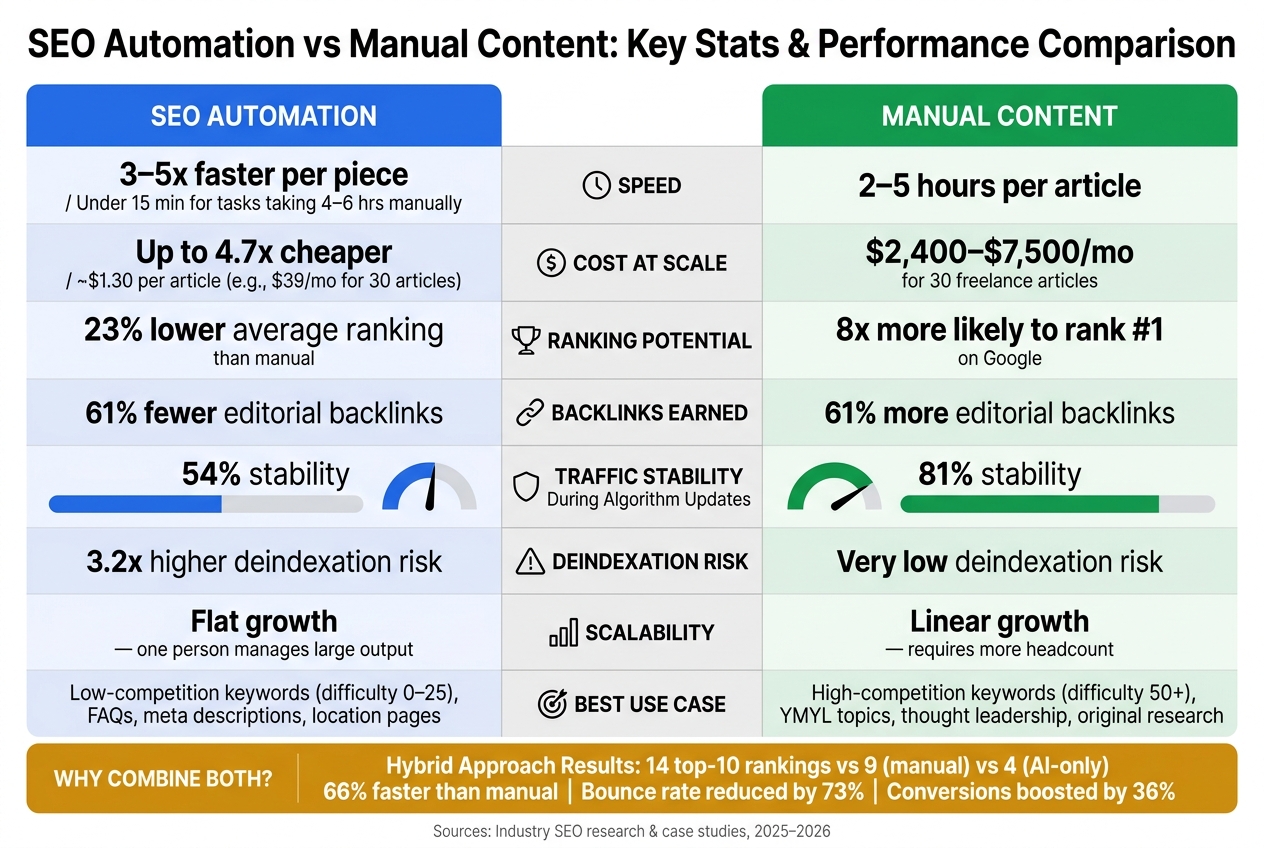 {SEO Automation vs Manual Content: Key Stats & Performance Comparison}
:::
{SEO Automation vs Manual Content: Key Stats & Performance Comparison}
:::
What to Compare
When deciding between automation and manual content creation, it's essential to focus on five main factors: content quality, scalability, cost, speed, and control over brand voice. Let’s break down how each approach excels in different scenarios.
When Automation Works Best
Automation shines when you need large-scale, consistent output without breaking the bank. It's particularly effective for:
- Low-competition informational queries (difficulty 0–25)
- Technical tasks like generating meta descriptions or schema markup
- Predictable content formats such as FAQs, product roundups, or location pages
For instance, with the help of AI tools, you can cluster thousands of keywords or audit over 5,000 pages in just minutes - tasks that could take an entire day when done manually [2]. Plus, automated content can be up to 4.7 times cheaper than manual efforts at scale [9].
When Manual Content Works Best
Manual content is the go-to option when authority and trust are critical. It’s ideal for:
- High-competition commercial keywords (difficulty 50+)
- YMYL topics (Your Money or Your Life) like finance, health, or legal advice
- Content requiring original research or authentic storytelling
Research shows that AI-generated content ranks 23% lower on average than human-written articles and earns 61% fewer editorial backlinks [7]. For example, in early 2026, a national ecommerce brand partnered with Nico SEO to target high-intent purchase terms. Instead of producing more content, they focused on just two carefully crafted articles, backed by behavioral signal campaigns. The result? They secured positions one and three within two weeks [4].
"Volume is a metric agencies use to justify invoices. It is not a metric Google uses to determine rankings." - Nicholas Bellanti, Founder, Nico SEO [4]
Pros and Cons Table: SEO Automation vs. Manual Content
| Factor | SEO Automation | Manual Content |
|---|---|---|
| Speed | 3–5x faster per piece [9] | 2–5 hours per article [9] |
| Cost at Scale | Much lower (up to 4.7x cheaper) [9] | Much higher (typically 3–5x more expensive) [8] |
| Ranking Potential | Ranks on average 23% lower [7] | Highest ranking potential |
| Backlink Appeal | Acquires 61% fewer backlinks [7] | Generally earns more citations |
| Deindexation Risk | 3.2x higher risk [7] | Very low risk |
| Traffic Stability | 54% stability across updates [7] | 81% stability across updates [7] |
| Scalability | Flat growth – one person can manage large outputs [8][13] | Linear growth – requires more headcount as output increases |
| Brand Voice Control | Needs human editing for strong voice | Naturally strong and authentic |
| Best Use Case | High-volume, low-competition content | Competitive niches, thought leadership, and YMYL topics |
How to Combine Automation and Manual Content for Better Results
How to Assess Your Needs and Resources
Finding the right balance between automation and manual input starts with assessing two key factors: the complexity of the content and how much it needs to reflect your brand's unique identity. Straightforward, repetitive content - like FAQs, location-based pages, or product roundups - is ideal for automation. On the other hand, content requiring expertise, personal insights, or a high level of trust - such as legal advice or thought leadership - is better suited for human creation.
A helpful guideline is the 30/70 split: about 30% of SEO tasks are data-driven and rule-based (e.g., rank tracking, technical audits, and schema generation), making them perfect for automation. The other 70%, which includes strategy, brand voice, and relationship building, needs human expertise [22]. Automating that 30% can save teams up to 15–20 hours of work each week [22].
"The question isn't 'AI or manual?' The right question is 'which 80% of my SEO work should an AI tool handle so I can focus on the 20% that requires human judgment?'" - Richard Castro, Founder of AnalySEO [2]
Hybrid Workflow Examples
A hybrid workflow combines the strengths of automation and human input by clearly defining which tasks are automated and which are refined by people. This approach doesn’t need to be overly complicated - what matters is setting up clear handoff points.
One popular method is the stage-gated process. For example, AI tools can generate keyword clusters and content outlines, create a first draft, and then pass it to a human editor to add insights, refine the tone, and include real-world examples. A final quality review ensures factual accuracy before publication [24]. NextGrowth.ai used a similar approach, where AI handled drafting, auditing, and revisions, with humans providing final approval. This process cut production time per article from 12–16 hours to just 4–5 hours, while improving top-20 ranking rates from 60% to 70% over 18 months [22].
In a 90-day experiment conducted by 8Spark between February and May 2026, three e-commerce sites were compared: one used pure AI, another was fully manual, and the third employed a hybrid approach. The hybrid site outperformed the others, achieving 14 top-10 rankings and 3,890 monthly visitors. In comparison, the manual site managed 9 rankings and 2,340 visitors, while the pure AI site only achieved 4 rankings and 847 visitors. The hybrid approach was also 66% faster to execute than the manual process [5].
Tools like LazySEO are well-suited for hybrid workflows. They handle tasks like automated keyword research, SERP analysis, and AI-generated drafts, leaving your team free to focus on fine-tuning the tone, adding personal experience, and ensuring the content genuinely meets audience needs.
Recommended Approaches by Business Type
The balance between automation and manual input depends on factors like team size, content goals, and risk tolerance. Here's a breakdown of recommended strategies:
| Business Type | Recommended Balance | Key Automation Targets | Human Focus |
|---|---|---|---|
| Small Business / Solo Founder | 80% Automation / 20% Manual | Technical audits, keyword research, initial drafts [2] | Final QA, brand voice, strategic decisions |
| Mid-Sized Company | 50% Automation / 50% Manual | Keyword clustering, content briefs, reporting [22][23] | Pillar content, case studies, SME insights |
| Enterprise / Large Site | 70% Automation / 30% Manual | Technical monitoring, meta-tag updates, internal linking [2][22] | High-stakes strategy, compliance review |
| Publishers / Blogs | 60% Automation / 40% Manual | FAQ generation, localized pages, programmatic reports [1][21] | Thought leadership, original research |
Conclusion: Picking the Right Approach for Your SEO Goals
There’s no one-size-fits-all answer here. The best approach depends on what you’re trying to achieve, how much time and budget you have, and - most importantly - what your audience actually wants.
Automation shines when it comes to tasks that require speed and scale, like technical audits, keyword clustering, or generating meta descriptions. On the flip side, content that demands a personal touch, deep expertise, or a strong brand voice is best left to human effort. Striking the right balance between these two methods is the foundation of a winning SEO strategy.
The numbers back this up. A hybrid approach - blending automation with human oversight - can lead to impressive results. For example, hybrid models have been shown to reduce bounce rates by 73% and boost conversions by 36% [9]. On the other hand, sites that relied heavily on AI-generated content without proper editorial review saw their organic visibility drop by 29% to 49% after Google’s January 2026 update [4]. It’s clear that automation without thoughtful oversight can lead to significant setbacks [4].
"The future of content production isn't automation replacing humans or humans resisting automation. It's intelligent integration where each approach amplifies the other." - TrySight [1]
LazySEO provides a great example of this hybrid model in action. Their workflow automates keyword research, SERP analysis, drafting, and publishing, giving your team more bandwidth to focus on strategy and quality. At $39/month for 30 SEO-optimized articles, it’s an affordable way to grow your organic traffic while maintaining high standards.
FAQs
::: faq
How do I know which SEO tasks to automate?
When managing SEO, it's helpful to divide tasks into two categories: mechanical and strategic.
Mechanical tasks are rule-based and repetitive, making them perfect for automation. Examples include:
- Analyzing keyword density
- Formatting meta descriptions
- Generating performance reports
On the other hand, strategic tasks require human judgment, creativity, and a deep understanding of your brand's voice. These are better suited for manual effort.
Here’s a simple way to decide: If a task is repeatable and relies on straightforward inputs and outputs, it’s probably a solid candidate for automation. Tasks that demand nuance or original thinking, however, should remain human-led. :::
::: faq
How much human editing does AI content need to rank?
AI-generated content in 2026 still needs a lot of human input to rank well. On its own, AI content often falls short in areas like originality, depth, and engaging the audience. To make it work, at least 30% of the content needs to be rewritten. This includes adding unique data, real-world case studies, and insights from experts. Human editors play a key role in fact-checking, aligning the tone with the brand, and ensuring the content reflects authority and builds trust with readers. :::
::: faq
What’s the safest hybrid workflow to avoid deindexing?
The safest hybrid workflow strikes a balance between automation and human oversight. Automation is great for tasks like gathering research, creating outlines, and drafting content. But the human touch is crucial for fact-checking, adding personalized insights, and ensuring the content reflects your brand's voice. A 70/30 split works well - let automation take care of 70% of the process, while humans focus on refining the remaining 30%. This approach helps maintain quality and lowers the chances of facing penalties. :::